

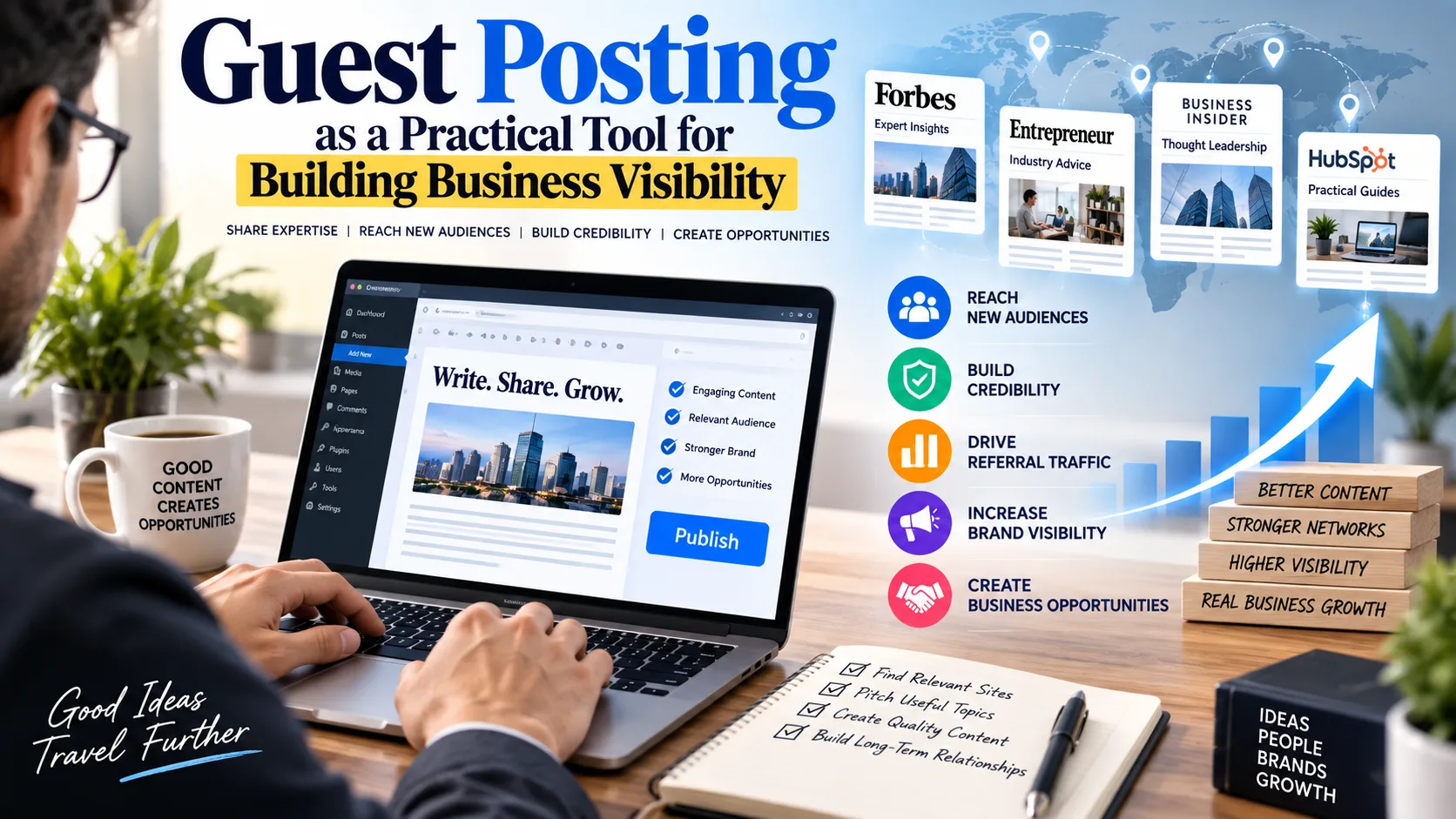
Businesses that publish useful ideas consistently often face a distribution problem rather than a writing problem. A strong article on a company website may help existing visitors, but it does not automatically reach the readers, journalists, customers, or professional communities that have not encountered the brand before. Contributing genuinely useful content to relevant third-party publications can address that gap, provided the work is approached as editorial communication rather than a shortcut to attention.
What Guest Post Placement Involves
Guest post placement is the process of identifying an appropriate external publication, developing a topic that serves its audience, preparing an original article, and arranging for it to be published according to that outlet’s editorial requirements. The objective is not simply to have a name appear elsewhere. It is to contribute information that readers can apply while giving them a clear, natural way to understand the author’s area of expertise.
For example, a software firm might explain how small teams can document an incident-response process. A local accounting practice could write about financial records entrepreneurs should prepare before tax season. A construction company might share a checklist for comparing project estimates. These subjects work because they solve a defined problem and do not require readers to make an immediate purchase.
Why Publication Relevance Matters
Audience fit should be the first consideration. An article about cybersecurity procedures belongs on a technology, business, or professional-services site, not on a general lifestyle page with no established interest in the subject. A mismatched placement may create a temporary impression of reach, but it rarely produces sustained attention or trust.
Relevance can be assessed through several practical questions:
- Does the publication regularly cover the industry or the reader problem addressed in the article?
- Would its typical readers recognise the topic as useful without needing extensive background?
- Does the site publish clear author information and maintain an identifiable editorial focus?
- Are older articles still accessible and written for people rather than only for search engines?
A focused publication with a smaller but engaged readership can be more valuable than a broad website where the subject feels out of place. This is particularly important for niche businesses, where credibility with the right audience matters more than raw traffic numbers.
Choosing Topics That Editors and Readers Can Use
The best contribution topics begin with a reader question. They are specific enough to be actionable but broad enough to be useful beyond one company’s products or services. “Five signs your business needs a clearer supplier contract” is more helpful than “Why our contract service is the best.” The first invites practical discussion; the second is unlikely to offer independent value.
Sources for worthwhile topic ideas include customer questions, common mistakes seen in the field, changes to regulations, recurring operational challenges, and lessons drawn from completed projects. News and media websites may also benefit from timely explainers that help readers interpret a development without repeating the headlines.
Build a Useful Article Structure
A clear structure makes an article easier to review and more useful after publication. Start with the problem and why it matters. Then explain the key terms, outline the steps a reader can take, and identify limitations or common errors. Where appropriate, conclude with a short checklist or decision framework. Avoid inflated promises, unsupported statistics, and broad claims such as “guaranteed results.”
Expertise is demonstrated through detail. Instead of saying that planning is important, explain which documents should be reviewed, what questions a decision-maker should ask, and what warning signs may require professional advice. This approach allows the article to stand on its own even for a reader who never visits another page.
Editorial Standards Should Come First
Every established website has its own expectations for tone, length, headings, links, images, citations, and author biographies. Reviewing several recent posts before pitching is a simple but essential step. It shows whether the outlet prefers short news-style analysis, long educational guides, opinion pieces, or case-based articles.
Originality also matters. Reusing the same article across multiple websites can weaken its editorial value and create confusion for readers. A better method is to adapt one central subject to each publication’s audience. One article may discuss the financial impact of delayed maintenance, while another examines the operational risks. The subject overlaps, but the insight and examples are distinct.
Handling Links Responsibly
A link should help the reader locate supporting material, a relevant guide, a useful tool, or more detailed context. It should appear where it genuinely extends the point being made, not as an interruption in a sentence. One contextual link is often enough when the article is informative and the destination is clearly related to the subject.
Businesses that need help managing outreach, publication research, and coordination can evaluate a guest post placement service as part of a wider content-distribution process. The important point is to retain control over relevance, accuracy, and the quality of the final article. External support does not remove the need for careful editorial judgment.
Measuring the Results Beyond Clicks
Clicks are useful, but they are only one indicator. A well-placed article can also create qualified referral visits, strengthen recognition in a specific market, lead to speaking or interview requests, and provide material that a business can share through its own newsletter or social channels. In some cases, the greatest value comes from being associated with a trusted publication rather than from immediate conversions.
Track where each article appears, the subject covered, referral traffic, engagement with linked pages, and any meaningful enquiries that follow. Over time, these records reveal which topics and publication types produce the most useful outcomes. They also prevent a business from repeating placements that look impressive on paper but do little for its actual audience.
Common Mistakes to Avoid
One frequent mistake is writing a sales page and calling it an article. Another is prioritising volume over publication quality. Businesses also lose credibility when they submit generic pitches, ignore editorial guidelines, or make claims they cannot substantiate. Finally, publishing on an irrelevant site simply because it is available can dilute rather than strengthen a brand’s message.
Effective guest posting is a disciplined form of communication. It requires a relevant publication, a topic shaped around reader needs, careful editing, and a clear understanding of what success looks like. When these elements are in place, external articles can become a durable part of a business’s content and media strategy rather than a one-time promotional exercise.