

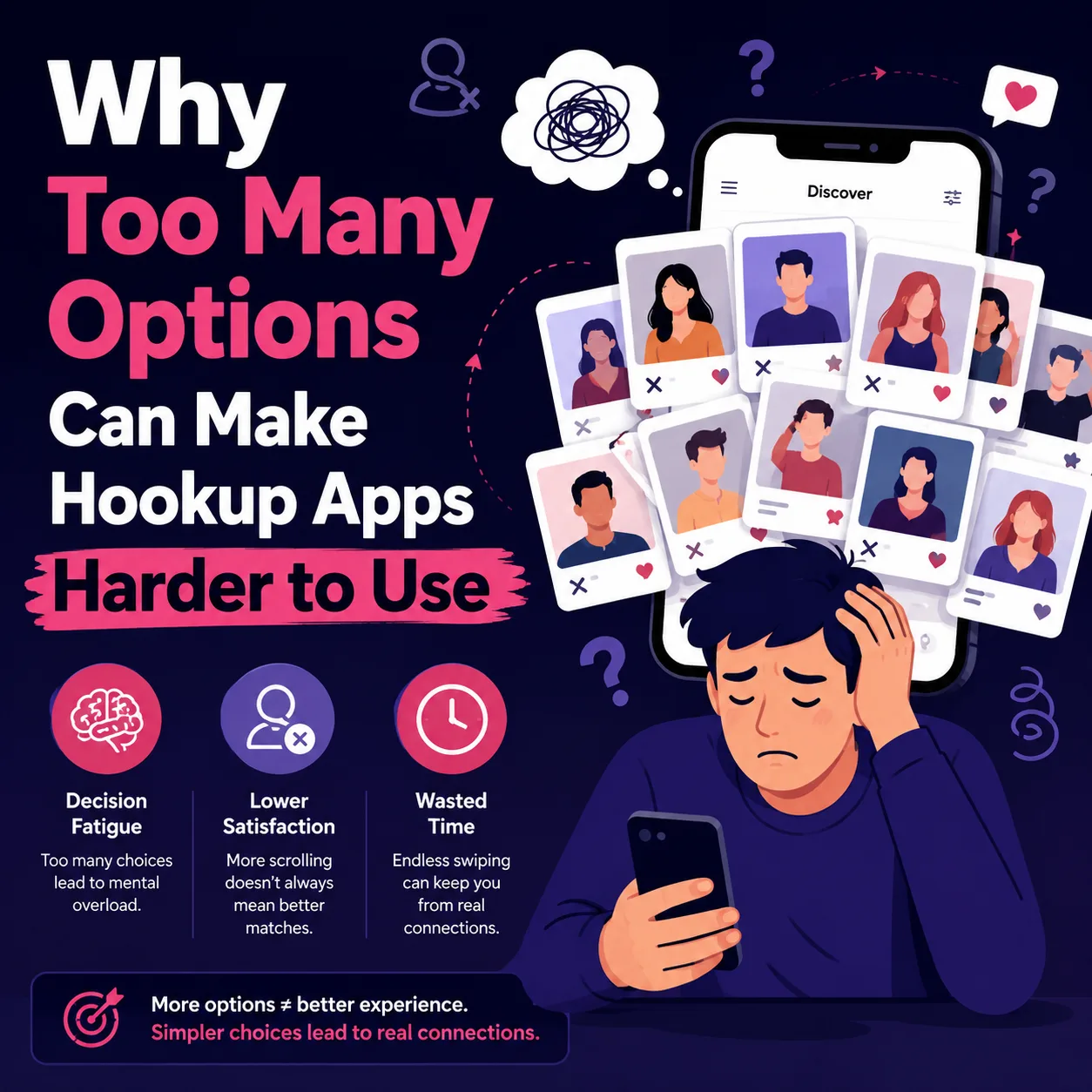
Hookup apps appear to solve a simple problem: more potential partners should create more chances to find a compatible person. Access is valuable, especially for people with small social circles, unusual schedules or preferences that are difficult to express offline. Yet a large pool also changes the way people evaluate one another.
Instead of asking whether one profile seems interesting enough to meet, a user may begin asking whether the next profile could be even better. The decision shifts from curiosity about a person to optimization across an apparently endless catalog. That shift can make swiping feel productive even when it produces fewer conversations, weaker attention and less willingness to follow through.
Public discussions about choosing a hookup site often focus on which service has the largest or most active audience. Those Reddit comments are anecdotal and cannot establish typical results. Audience size matters, but it is not the entire experience. The number of profiles someone can access and the number they can evaluate thoughtfully are different quantities.
Access Is Helpful Until Browsing Becomes the Goal
Online dating expanded access beyond the people someone happens to meet through work, friends or local social spaces. A major psychological review by Finkel and colleagues described access as one of the defining services of online dating, alongside communication and matching. The authors noted that online platforms can expose users to people they would otherwise be unlikely to encounter.
That advantage is real. A larger pool can include more people who share a user’s intentions, schedule, orientation or boundaries. It may be especially important in a smaller city or for someone seeking a less common arrangement.
The problem begins when access stops serving selection and turns into continuous browsing. Swiping provides immediate feedback: another profile appears, another decision is completed and another possibility remains available. Starting a conversation is slower and uncertain. Meeting someone requires time, vulnerability and coordination. Browsing can therefore feel easier than pursuing the matches already available.
[Inference] This creates a practical mismatch between what the user says they want and what the interface rewards in the moment. The user may want a real meeting while repeatedly choosing the action that delays one.
Repeated Evaluation Can Create a Rejection Mind-Set
A 2020 paper by Tila Pronk and Jaap Denissen examined what happened as participants evaluated sequences of potential partners. Across three studies, participants became increasingly likely to reject profiles as they encountered more options. The researchers described this pattern as a “rejection mind-set.”
The average chance of accepting a profile fell by 27% from the first option to the last across the studies. The researchers linked the pattern to declining satisfaction with the images and growing pessimism about perceived dating success. However, the studies did not identify one universal number of profiles at which the effect began, and some results varied by gender and experimental condition.
This matters because rejection can become the default action. Early in a session, a user may notice reasons to be interested. Later, they may scan primarily for reasons to dismiss. A slightly awkward bio, an average photograph or one uncertain detail becomes sufficient to move on because another option is immediately available.
The research does not show that every long swiping session causes the same result. It does suggest that decisions can change across a sequence even when users believe they are applying a stable personal standard.
Large Choice Sets Can Make a Selected Match Feel Less Satisfying
Choice does not end when someone accepts a profile. The rejected alternatives remain mentally available, particularly when the app makes returning to the pool effortless.
In an experiment involving 152 undergraduate participants, Jonathan D’Angelo and Catalina Toma compared choices made from sets of six and 24 potential partners. Participants who selected from the larger pool and could reverse their decision were the least satisfied with their chosen option one week later. They were also more likely to change the selection.
The experiment had important limitations. Its participants were young undergraduates, and selecting a profile in a study is not identical to managing a real conversation or arranging a casual meeting. The finding should not be treated as a rule for every app user.
It does illustrate a familiar decision problem: a chosen person can remain in competition with everyone not chosen. Instead of learning whether the match works, the user continues comparing them with imagined alternatives. Because those alternatives are still profiles rather than real interactions, their disadvantages are easier to overlook.
A Profile Contains More Comparable Data Than a Real Encounter
Apps make people easy to sort. Age, distance, height, interests, photos and short prompts sit in repeatable positions. That structure is useful for basic compatibility, but it can encourage users to treat every visible field as a purchasing specification.
Offline attraction rarely arrives as a complete set of comparable attributes. Someone may become appealing through humor, timing, voice, movement or the way a conversation develops. A static profile can represent some of those qualities, but it cannot reproduce the interaction.
When dozens of profiles are evaluated in one session, measurable details become convenient shortcuts. A user may reject people who do not meet an increasingly narrow image of the ideal, even when some of those details would matter little during an actual meeting.
[Inference] The more tired the user becomes, the more likely they may be to rely on simple filters rather than interpret a profile as an incomplete introduction. This is a plausible decision pattern, not a confirmed outcome for every individual.
AI in SEO
The same broader trend can be seen across the internet. Digital platforms increasingly use AI to organize information, personalize recommendations and predict what users may want to see next. Similar changes are already reshaping areas such as search and content discovery, as explored in AI-powered SEO strategies.
Personalization can reduce unnecessary information, but it also creates an important trade-off: when algorithms continuously provide new options, users may spend more time consuming recommendations instead of acting on the options they already have.
Endless Possibility Can Delay Commitment to the Next Step
Commitment in casual dating does not have to mean exclusivity or a relationship. It can mean something much smaller: giving one conversation focused attention, scheduling a brief meeting or deciding that a match is worth exploring before reopening the app.
An endless pool makes even that limited commitment feel expensive. Replying to one person means not browsing for a few minutes. Confirming Friday night means declining possibilities that may appear before Friday. The user is not necessarily afraid of commitment in a broad psychological sense. They may simply experience a constant opportunity cost generated by the interface.
This can produce a collection of weak matches instead of one developed interaction. Each conversation receives enough attention to remain open but not enough to progress. Slow replies then make every participant appear less interested, which encourages more swiping and creates another round of shallow conversations.
The cycle does not require anyone to behave maliciously. It can emerge when many people keep options open at the same time.
Could AI Assistants Change How We Browse Dating Apps?
AI is increasingly changing the way people interact with websites and digital platforms. Instead of manually opening pages, comparing options and repeating the same tasks, AI browser assistants can help users navigate information and complete actions more efficiently. A similar shift may eventually influence how people manage large pools of dating profiles.
Rather than encouraging endless browsing, future AI-powered assistants could potentially help users organize conversations, remember important preferences and reduce repetitive decision-making. The broader development of AI browser assistants shows how artificial intelligence is moving beyond simple chatbots and toward tools that can actively assist users while they navigate the web.
The important question, however, is whether automation improves decisions or simply makes it easier to evaluate even more options.
How AI Tools Work
AI-driven recommendations can feel simple from the user’s perspective, but the technology behind them often involves data analysis, pattern recognition and prediction models. Understanding how AI tools work can make it easier to understand why modern platforms increasingly personalize feeds, recommendations and search results based on user behavior.
In dating environments, personalization could theoretically reduce irrelevant options. However, better recommendations do not automatically solve the problem of continuous comparison if users continue treating every new profile as a possible upgrade.
The Evidence Is Not One-Sided
Choice-overload research is not a reason to claim that dating apps would work better with almost no options. Larger pools can improve access and allow people to find compatible partners who would otherwise remain outside their social world.
Not every study finds that more swiping reduces well-being or produces a clear overload effect. Results can depend on how choice is measured, whether profiles represent real available partners, how much information is shown and whether participants expect an actual interaction. A prototype-app study conducted with people aged 18 to 30, for example, reported no observed effect of a larger profile set on well-being and did not reproduce all earlier rejection findings.
The correct conclusion is therefore narrower: more profiles can change decision behavior under some conditions, but the effect is not universal and the research does not establish one ideal daily swipe limit.
That uncertainty is useful. It means users do not need to follow an arbitrary number invented for an article. They can watch for signs that their own judgment is becoming less attentive.
Notice When Your Standard Changes During a Session
The best signal of overload may not be the number of profiles viewed. It may be the quality of the decisions being made.
At the beginning of a session, can you explain why you accepted or rejected a profile? Later, are you dismissing people almost automatically? Do bios stop registering? Do several profiles begin to feel interchangeable? Are you reopening the app while leaving compatible matches unanswered?
These patterns do not prove a clinical problem or addiction. They indicate that the session is no longer serving its intended purpose.
Another clue is moving criteria. A user may start with a few meaningful requirements, then add new disqualifiers as the pool continues. The goal quietly changes from finding a suitable person to avoiding any profile with an imperfection.
[Inference] A pause is likely more useful at that point than stricter filtering. Tired evaluation produces more decisions, but those decisions may not reflect what the user values when fully attentive.
Replace the Infinite Pool With a Small Working Set
The app may contain thousands of profiles, but a user does not have to treat all of them as active options at once. A small working set makes the process more concrete.
One approach is to stop swiping after receiving a manageable number of promising matches. Read those profiles again, send specific messages and see which conversations become reciprocal. Return to discovery only after the active conversations have clearly progressed or ended.
This is not about forcing interest. A match that ignores questions, violates a boundary or reveals an important incompatibility should not receive extra chances merely because it entered the working set. The purpose is to evaluate real interaction before replacing it with another hypothetical possibility.
A user can also define a few meaningful criteria before opening the app. Intent, location, availability and important boundaries may matter. Minor photo preferences or an imperfect prompt may not deserve the same weight. Predefined criteria make it easier to notice when a long session has turned ordinary preferences into rigid demands.
Move From Profile Evaluation to Conversation Earlier
A profile is designed to support an initial decision, not a complete judgment of compatibility. After the basic requirements are met, conversation provides information that further swiping cannot.
Ask a question connected to the person’s bio. Clarify what casual means to each person. Discuss timing, privacy and the kind of meeting both would consider. A reciprocal exchange quickly shows whether the profile represents someone willing and able to participate.
Do not run every match through a long interview. The aim is to leave catalog mode and enter interaction mode. Voice, humor, curiosity and respect become visible only when both people contribute.
When the conversation is comfortable and the basic safety checks make sense, a short public meeting may be more informative than another week of profile analysis. RAINN recommends meeting in a public, populated place, sharing the plan with a trusted person and maintaining independent transportation.
Stop Using Matches as a Score
Matches are easy to count, which makes them tempting as a measure of progress. Yet a high match total can coexist with no meaningful conversations and no meetings.
A more useful private measure is conversion between stages: profiles viewed, intentional likes, reciprocal conversations and plans that both people confirm. This does not need to become a spreadsheet. The point is to distinguish activity from movement.
[Inference] If a user repeatedly adds matches without replying to existing ones, the next helpful action is probably not another swipe. It is answering, closing or unmatching the conversations already open.
This approach also respects other users. A person should not be kept as a backup option through occasional low-effort messages while the search continues indefinitely. If interest is gone, a polite conclusion or unmatch is clearer than maintaining a dormant conversation for validation.
Keep the Goal Proportionate
Casual dating does not require a perfect candidate. It requires sufficient attraction, compatible intentions, mutual respect and a plan both people want. Searching for certainty through more profiles is unlikely to provide information that only interaction can reveal.
This does not mean lowering important standards. Safety, consent, honesty and core boundaries remain non-negotiable. The distinction is between protecting those requirements and trying to eliminate every ordinary uncertainty before speaking to someone.
A profile can be suitable without being extraordinary. A conversation can be worth continuing without proving where it will lead. A first meeting can be useful even if it ends with both people deciding not to meet again.
Choice becomes manageable when the decision is limited to the next reasonable step rather than the entire future of the connection.
The Ultimate Guide to AI Tools
AI is becoming part of nearly every digital workflow, from research and writing to automation, design and online search. The growing ecosystem of AI tools shows how quickly software is shifting from passive interfaces toward systems that actively help users make decisions.
For dating platforms, that could eventually mean smarter filtering, better conversation support and more personalized recommendations. But technology cannot completely replace the human judgment involved in deciding whether a conversation or real interaction is worth pursuing.
Frequently Asked Questions
Does research prove that dating apps create choice overload?
No. Several studies have found increased rejection or lower satisfaction under particular conditions, but results are not universal. Study design, participant group, profile set and whether choices involve real partners can affect the outcome.
Is there an ideal number of profiles to view each day?
The available research does not establish one number that applies to everyone. Attention quality is a more practical guide. Stop when profiles blur together or decisions become automatic.
Are more options always worse?
No. Larger pools improve access and may help users find people who share less common preferences or circumstances. Problems can arise when continuous evaluation replaces conversation and follow-through.
Should I stop swiping as soon as I get one match?
Not necessarily. One match may never reply or may reveal an incompatibility. The useful principle is to keep the active set small enough that each promising conversation can receive genuine attention.
Why do matches feel less exciting after a long session?
One study linked repeated profile evaluation with declining satisfaction and a more rejecting orientation. Fatigue and continued comparison may also contribute, but an individual’s exact reason cannot be confirmed without more information.
How can I tell whether I am swiping too much?
Look for behavior rather than a fixed time limit: automatic rejection, unread bios, changing standards, repeated reopening of the app and neglected conversations can indicate that browsing is no longer helping.
Final Thoughts
Dating apps offer something genuinely useful: access to people who would otherwise remain strangers. The difficulty is that access can expand long after it has stopped improving the immediate decision.
The research does not support a simplistic claim that fewer profiles always produce better outcomes. It does show that repeated evaluation can make people more rejecting or less satisfied in some settings. That is enough reason to use abundance deliberately.
A user does not need to evaluate the whole pool. They need to notice a plausible match, begin a reciprocal conversation and decide whether the next step feels worthwhile. The goal is not to find the best profile that could theoretically appear. It is to recognize when a real interaction deserves more attention than the next swipe.