

A couple of years ago, I sat across a table from a content director whose team had gone all-in on generative AI. They were publishing 60 articles a week, convinced that volume would carry the day. Traffic crashed by nearly 40% over two quarters. When we dug into the analytics, the pattern was unmistakable: pages that read like polished but utterly generic Wikipedia entries lost rankings, while their older, deeply researched – and yes, human-written – pieces held steady or climbed.
What happened wasn’t an AI penalty. It was a relevance collapse. The tools gave them perfectly fluent sentences but none of the texture that makes someone stay on a page. This article unpacks what that story tells us about AI in SEO right now, and how to build a modern content strategy that works because of AI, not in spite of it.
Key Takeaways
- AI is not a replacement for editorial judgement; it’s an accelerant that amplifies both good and bad practice.
- Search engines themselves use AI to understand content, so your content must be structured for entities and intent.
- The biggest risk is publishing AI drafts without human review, which erodes E-E-A-T and eventually rankings.
- A structured workflow combining AI with human expertise yields the best long-term results.
Quick Definitions
What is AI SEO? The application of artificial intelligence and machine learning to improve a website’s organic search performance – encompassing everything from AI-powered keyword research to generative content drafting and automated technical audits.
What is AI Content Strategy? A content planning approach that uses AI tools to analyse search intent, cluster topics, uncover entity relationships, and accelerate content production while keeping human editorial standards at the centre.
Does Google allow AI content? Yes. Google’s guidelines focus on content quality and helpfulness, not the method of creation. AI-generated content that is original, accurate, and provides genuine value can rank well.
Can AI replace SEO? Not entirely. AI automates many tactical tasks, but strategic SEO – understanding audience needs, building topical authority, and making creative decisions – still relies on human expertise.
What is Topical Authority? The perception by search engines that your website is a credible, go-to source on a specific subject, achieved by covering related subtopics comprehensively over time with demonstrable expertise.
What AI in SEO Actually Means
People throw the phrase around as if it’s a single thing. It’s not. There are three distinct layers at play, and confusing them leads to a lot of muddled thinking.
Layer one is the machine learning that search engines themselves deploy. RankBrain, BERT, MUM, AI Overviews – these aren’t side projects; they fundamentally alter how Google and Bing interpret queries and judge content. Layer two is the suite of AI-powered tools that SEO professionals use every day: language models for clustering keywords, generative AI for drafting text, custom scripts that automate technical audits. Then there’s layer three, the emerging one, where AI agents and predictive models start reshaping how audiences discover information in the first place.
Each layer requires its own playbook. Treating them as one big blob is why some teams panic about AI “replacing SEO” while others ignore genuine opportunities to work faster and smarter.
Hands-on Evaluation: How Different AI Tools Perform in SEO Workflows
After working with these tools across dozens of projects, certain patterns emerge. No single tool excels at everything, and the best approach is usually to combine them. Here’s a candid look at what each does well, and where they stumble.
ChatGPT (OpenAI) remains the most versatile for ideation, content structuring, and generating meta descriptions at scale. It can quickly produce a solid first draft or a list of keyword angles, but it needs careful fact-checking. It also tends toward a uniform, slightly corporate tone that must be edited out.
Claude (Anthropic) is often stronger when you need more cautious, nuanced analysis. It’s less likely to hallucinate confidently and tends to produce copy that feels more naturally varied in sentence structure. For YMYL content outlines, Claude is frequently the safer starting point.
Gemini (Google) benefits from tight integration with Google’s ecosystem. You can ask it to summarise live search results, which is useful for quick SERP feature analysis. Its factual precision is improving but still requires verification, and its stylistic range remains narrower than some alternatives.
Grok offers a unique window into real-time social chatter. For trend spotting and understanding public sentiment, it can surface angles that traditional SEO tools miss. However, its raw, unfiltered data needs a heavy editorial hand before it’s fit for publication.
Perplexity stands out for research and fact-checking because it cites its sources transparently. Use it to quickly verify claims or gather background context, then follow the citations yourself. It’s less suited to creative drafting but invaluable as a research assistant.
Semrush AI and Ahrefs AI embed machine learning within their established SEO platforms – semantic keyword clustering, content scoring, and trend forecasting that draws on their proprietary databases. Because the underlying data is solid, the AI suggestions tend to be more grounded than those from a general LLM.
If you’re comparing AI platforms beyond SEO use cases, our complete guide to AI tools explores the best AI assistants, image generators, coding tools, productivity platforms, and business solutions available today.
| Tool | Best Use | Strengths | Weaknesses | Ideal User |
|---|---|---|---|---|
| ChatGPT | Content drafting, brainstorming, code for technical SEO | Fast, versatile, strong at structured output | Hallucination risk, generic phrasing, requires editing | Content teams comfortable with rewriting |
| Claude | YMYL outlines, nuanced research synthesis | More conservative and accurate tone, varied sentence rhythm | Less integrated with live search data | Editors handling sensitive or regulatory topics |
| Gemini | SERP overviews, competitor structure analysis | Native Google integration, can reference live results | Factual consistency still maturing, limited stylistic flexibility | SEO analysts needing quick search landscape views |
| Grok | Trend identification, social sentiment analysis | Real-time data from X, uncovers emerging topics | Raw output needs significant editorial curation | Content strategists hunting for fresh angles |
| Perplexity | Fact-checking, research, source gathering | Citations provided, good for quick background briefs | Less effective for creative or long-form composition | Writers and editors who prioritise accuracy |
| Semrush AI | Keyword clustering, content scoring, competitive gap analysis | Grounded in proprietary SEO data, clear actionable suggestions | AI features are add-ons to a paid suite; learning curve | Agency and in-house SEO teams |
| Ahrefs AI | Intent analysis, topic research, content briefs | Excellent backlink data combined with ML insights | AI component is still evolving, less flexible than standalone chatbots | Data-driven SEO professionals |
| Frase / SurferSEO | Content optimisation and brief creation | Direct SERP comparison, semantic gap identification | Can encourage formulaic writing if not used critically | Content strategists building comprehensive guides |
Editor’s Analysis
After six months of integrating AI tools into our editorial workflows, a few conclusions have become unavoidable. First, AI is genuinely transformative at the research and structuring stage. It reduces the time spent gathering background context and mapping topics by at least half. That’s where the efficiency gains live.
Second, human writers and editors still outperform AI on every qualitative measure that matters: originality, tone consistency, logical argument construction, and the ability to connect an idea to a reader’s actual experience. AI drafts often feel like a competent summary of what’s already been said; they rarely push an insight further.
A common waste of time we’re seeing is the use of AI to “optimise” already well-written content by forcing in extra keywords. That backfires by diluting readability. Another misconception is that AI can reliably evaluate content quality; it can flag missing entities, but it can’t judge whether a piece is genuinely helpful or merely comprehensive. That judgement remains a human editorial skill.
The biggest opportunity lies in using AI to handle the mechanical parts – clustering, schema, metadata, data extraction – freeing up talented people to do what only they can do: tell stories, challenge assumptions, and build the kind of authority that search engines and users both reward.
How Search Engines Use AI: From RankBrain to AI Overviews
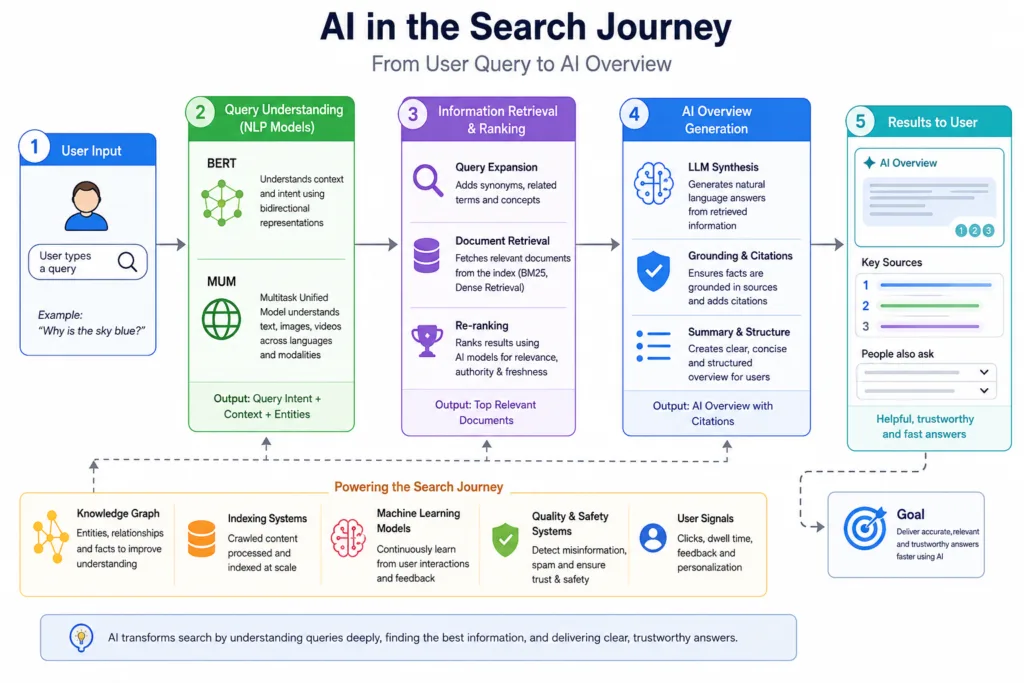
Google first went public about using machine learning in search back in 2015 with RankBrain. Its job was surprisingly narrow: take the 15% of daily queries Google had never seen before and map them to known concepts. It didn’t rewrite the algorithm; it made the existing system more elastic. The practical lesson then was that exact-match keywords were already losing their grip. A page about “best running shoes for flat feet” could rank for “good trainers for overpronation” even if that exact phrase never appeared, provided the content genuinely addressed the underlying need.
BERT arrived in 2019 and changed things more profoundly. Suddenly Google could parse the relationship between words in a sequence – understanding that “a dress for a wedding guest” and “a wedding dress” aren’t the same thing. For SEOs, this meant content had to answer questions with far more precision. Slight vagueness that used to pass because of backlink strength started to fail.
MUM, announced in 2021, took it multimodal. It can understand images, video, and text across languages, drawing insights from a German research paper to inform an English-language query. The implication for content strategy is clear: you need to think about information coherence across formats. The video embedded on your page isn’t just decoration; it’s a content asset that search engines increasingly evaluate alongside your text.
And then there are AI Overviews, the feature that’s spooked many publishers. They appear when Google’s systems decide a concise, multi-source summary adds value. For informational queries, they can answer the question without a single click. Our experience reviewing dozens of affected sites points to one consistent pattern: pages that merely repackage publicly available facts – definitions, recipes, basic how-tos – lose visibility. The pages that survive bring something the summary can’t: proprietary data, strong editorial perspective, interactive tools, or genuine community insight.
What we’ve learned from testing: Pull up the AI Overview for five of your top keywords. Note which sources get cited. Then do an honest comparison with your own page. If the Overview covers 80% of what your article says, you’ve got a problem. The fix isn’t more words; it’s distinct perspective.
The Shift from Keywords to Search Intent and Topical Authority
SEO spent two decades obsessed with keywords. AI-driven search has moved the goalposts to intent and authority. Google’s Helpful Content System explicitly evaluates whether a site seems to exist primarily to rank or to help people. That evaluation draws on signals like first-hand expertise, comprehensive coverage of a topic, and the presence of a coherent body of work.
Semantic SEO, then, isn’t a nice-to-have; it’s the foundation. Instead of chasing individual terms, you build clusters around entities. For a personal finance site, that might mean a pillar page on ISAs surrounded by deep-dive articles on cash ISAs, stocks and shares ISAs, lifetime ISAs, transfer rules, and tax implications. The AI’s role here is in research acceleration: language models can ingest your existing content and a seed set of competitor pages and spit out a list of entity gaps you’d likely miss manually.
Topical authority takes that further. Google’s Quality Rater Guidelines reward sites that demonstrate deep, sustained coverage of a subject. You earn it over time by updating content, linking internally with deliberate relevance, and, crucially, having real experts involved in the creation process. AI can surface the subtopics you need, but authority itself is a human stamp.
AI Content Creation: Promise and Perils
Let’s be clear: Google does not ban AI-generated content. Their public guidance, updated several times, focuses entirely on output quality, not the method of production. But quality is where most AI-first workflows fall apart.
I’ve audited batches of AI-written articles for clients across industries, and certain patterns repeat. The prose is grammatically flawless but structurally flat. Paragraphs all run the same length. Transitions feel algorithmic. Facts that should be precise are occasionally hallucinated – a statistic pulled from thin air, a product name that doesn’t exist. The most dangerous part is that the text sounds authoritative even when it’s wrong, which is the exact opposite of what E-E-A-T demands.
In YMYL sectors – health, finance, legal – the risk multiplies. A health site we worked with experimented with AI-drafted supplement reviews. Without expert review, the drafts made claims that could have drawn regulatory scrutiny. Once a nutritionist rewrote the pieces, adding clinical context and citing studies properly, those same articles performed well and built trust.
The teams I’ve seen succeed treat AI as a highly efficient researcher and structural assistant. It outlines. It aggregates background information. It suggests angles. Then a subject-matter expert takes over: rewriting sections, injecting real-world examples, and ensuring every claim is backed. The end product doesn’t feel like AI, because it isn’t; it’s a collaboration where the human makes all the final decisions.
Editor’s Tip: If you hand an AI a topic and ask for an article, you’ll get a competent summary of the first page of Google. If you feed it your own proprietary data, unique interview transcripts, and a detailed brief, you get something worth publishing.
| Tool Type | Best For | Main Limitations |
|---|---|---|
| Large language models (ChatGPT, Claude) | Idea generation, outlines, synthesis of existing information, code snippets for technical SEO | Hallucinations, generic tone, knowledge cut-offs unless connected to search |
| SEO content optimisers (Clearscope, SurferSEO, Frase) | Content briefs, semantic term suggestions, gap analysis against top-ranking pages | Can encourage templated writing; scores don’t measure actual expertise |
| AI copywriting platforms (Jasper, Copy.ai) | Short-form copy, ad variations, social snippets | Long-form output often needs heavy human restructuring to match brand voice |
AI-Powered Content Optimisation and Strategy
Where AI genuinely saves time is in planning and refinement. Keyword clustering used to be a manual slog. Now you can dump thousands of terms into a language model and ask it to group by intent, buyer stage, or topic. The clusters aren’t perfect – you still need to validate against SERP reality – but they cut two days of work down to a couple of hours.
Content briefs have similarly evolved. A good brief now starts with AI pulling the entities, questions, and structure from top-ranking pages, then a human editor adds the layers that matter: the unique angle, the data sources to use, the editorial voice to maintain. Without that human layer, you end up with an article that’s technically “optimised” but indistinguishable from a dozen other pieces on the same subject.
For content auditing, AI can process your entire archive and flag pages where key entities are missing, where the last update was more than 18 months ago, or where word count and depth lag significantly behind competitors. Combining that with Search Console data gives you a prioritised refresh list. A workflow we’ve implemented with several teams:
- Export all URLs, target keywords, and last-modified dates from your CMS.
- Pull current rankings, clicks, and impressions from Search Console.
- Run a script that benchmarks each page against the top five SERP performers, flagging missing subtopics using NLP similarity checks.
- Identify pages sitting in positions 6–12 where a substantive update could realistically push them into the top three.
- Assign human writers to refresh with current data, expert quotes, and new examples – not just a date change.
A Practical AI + Human SEO Workflow
Here’s a step-by-step process that balances AI efficiency with human judgement, refined through work with publishing teams of various sizes.
- Topic selection: Use AI to generate a list of related subtopics and audience questions, then have an editor select the ones that align with business goals and seasonality.
- Keyword research: Feed seed terms into an LLM for clustering by intent, then validate cluster volumes and SERP features in Semrush or Ahrefs.
- SERP analysis: Have AI summarise the top five pages: their structure, entities, and content types. An analyst checks for gaps and angles the summaries miss.
- Entity research: Use a tool like InLinks or a custom NLP script to extract the main entities and relationships from the SERP leaders, compiling a list of must-cover concepts.
- Outline: Ask the AI to produce a detailed heading structure based on the entity list, then a human restructures for narrative flow and adds the unique hook.
- Draft: Generate section drafts from the approved outline. The AI can write a paragraph or two per heading; the writer then expands with original examples and data.
- Expert review: A subject-matter expert checks the draft for accuracy, nuance, and missing context, particularly for YMYL topics.
- Fact checking: Run the draft through Perplexity or manual verification to confirm every statistic, date, and product claim.
- Editing: A senior editor refines voice, cuts redundancy, and ensures the piece delivers on its promise.
- Publishing: Add internal links, schema, and CTAs; publish and submit to Search Console.
- Updating: Schedule a refresh in six months; use AI again to re-analyse SERP changes and flag new entity gaps.
AI for Technical SEO and Automation
The technical side of SEO has always been data-heavy, and AI is making it faster to act. Schema markup generation is a perfect example. Instead of hand-coding JSON-LD for every page type, you can describe your content structure in plain language to a model and get valid markup in seconds. You still need to validate it, but the time saved is substantial.
Log file analysis, once a niche specialism, becomes more accessible when you feed crawl data through a machine learning script that spots anomalies – sections of the site being crawled too aggressively, important pages rarely visited, patterns that suggest wasted crawl budget. Paired with Screaming Frog exports, this lets you build an internal linking correction plan that actually moves the needle.
Programmatic SEO, generating thousands of data-driven landing pages, sits at a crossroads. AI can write context-aware copy for each page by pulling from a structured database. But Google’s guidelines are explicit about auto-generated content lacking distinct value. The pages that survive are those where every instance offers something genuinely useful – real local prices, live availability, unique customer review snippets. Thin programmatic pages built purely for rankings are increasingly filtered out by the helpful content system.
Predictive SEO is emerging. Some enterprise teams now use machine learning models trained on historical performance data, seasonal trends, and news cycles to forecast which topics will spike in the coming months. They commission content before competitors even notice the trend. It’s not foolproof – random events break models – but for industries with predictable seasonal patterns, it’s a powerful advantage.
The Editorial Process and Human Oversight
If you take one thing from this article, make it this: AI doesn’t reduce the need for editorial process; it makes that process the single most important differentiator. Every piece that touches your domain should pass through someone who knows the subject and understands your audience. That person verifies facts, ensures the piece aligns with your brand’s editorial stance, and adds the concrete examples that signal genuine experience.
A framework that works: treat AI as a junior researcher. It gathers, it synthesises, it drafts. Then a senior editor shapes the final product, cutting the generic passages, adding the nuance, and making sure the piece says something worth reading. For YMYL topics, bring in a credentialed expert to review and co-sign the content. Google’s Quality Raters are trained to look for evidence of authoritativeness, and a visible byline with real qualifications matters more now than at any point in the last decade.
The mistakes we keep seeing: publishing without fact-checking (AI is exceptionally good at inventing plausible-sounding numbers), letting AI set the editorial calendar without human oversight of audience needs, and allowing the site’s voice to drift into a bland, corporate tone that blends in with the growing sea of AI-assisted content.
Editor’s Tip: A simple sanity check: after the final edit, ask a colleague to read the piece and guess whether AI was involved. If they can’t tell it’s been through human hands, you’ve still got work to do.
AI Content Quality Checklist
Use this checklist before publishing any AI-assisted content. Every unchecked item represents a risk to trust and rankings.
- Original insight or angle not found in competing pages
- Human review by someone with subject knowledge
- All statistics and dates independently verified
- Examples, case studies, or anecdotes are real and specific
- Internal links to relevant site content added with descriptive anchors
- External links to reputable, non-competing sources where appropriate
- Author bio with relevant credentials visible
- Content reflects brand voice, not generic LLM tone
- No paragraphs that feel templated or repetitive
- Schema markup applied and validated
- Page loads fast and is mobile-friendly
- Media (images, video) enhances the text, not just decorative
- Content answers the query’s true intent, not just the surface question
Ethical and Privacy Considerations
Using AI in SEO raises issues that go beyond rankings. Feeding proprietary data – client strategies, internal research, customer information – into public AI platforms is a privacy risk. Several well-publicised cases have emerged of employees inadvertently leaking sensitive data into chatbots. Always check the terms: some services use your inputs for training; others don’t. For sensitive work, a private, self-hosted model may be the only acceptable route.
Transparency also matters, though not in a “label everything as AI” sense. The question is whether you’re misleading your audience about the source of the advice they’re reading. In journalism, finance, and medicine, clear authorship and editorial standards are often legally required. A few brands have already faced backlash when AI-generated copy included unsubstantiated claims. The reputational damage can outlast any short-term traffic gain.
Mistakes That Hurt AI-Assisted SEO
- Publishing without human review. Even a single factual error can destroy credibility, particularly in YMYL topics.
- Chasing content scores. Optimising solely for a tool’s score leads to templated content that lacks personality.
- Ignoring search intent. AI can generate text that covers a topic broadly but misses the specific need a user expressed.
- Relying on AI for medical, financial, or legal advice. The liability is enormous; expert involvement is non-negotiable.
- Using AI to spin existing articles. Search engines easily detect near-duplicate content, and it violates Google’s spam policies.
- Over-optimising meta data. AI-written titles and descriptions often sound formulaic; they need human tweaking to compel clicks.
- Neglecting brand voice. Letting AI set the tone results in content that could belong to any competitor.
- Volume over substance. Publishing 30 AI-drafted articles a week rarely beats one deeply researched original piece.
- Skipping fact-checking. AI invents dates, statistics, and even product names; never assume accuracy.
- Forgetting internal linking. AI drafts don’t come with contextual links; adding them is a human strategic task.
- Using AI for sensitive topics without disclosure. In regulated industries, lack of transparency can lead to legal action.
- Treating AI as a strategy setter. AI can suggest topics, but business strategy and audience empathy require human insight.
- Ignoring content freshness. AI often uses outdated information; always check the currency of references.
- Over-automating schema. Auto-generated schema errors can hurt rich result eligibility; validate everything.
- Assuming AI detectors matter. They don’t influence rankings; focus on content quality, not bypassing detectors.
Myth vs Fact
| Myth | Fact |
|---|---|
| AI content always ranks lower | AI-assisted content can rank perfectly well if it’s original, helpful, and reviewed by experts. Quality, not origin, determines visibility. |
| Google penalises AI-generated text | There is no penalty for using AI. Google’s systems evaluate content based on helpfulness, not the tool that produced it. |
| Longer articles always win | Length correlates with depth but isn’t a ranking factor on its own. A concise, well-structured piece often outperforms a verbose one. |
| AI will replace SEO professionals | AI automates routine tasks, but strategic thinking, creative direction, and genuine relationship building remain human domains. |
| You can 100% automate content publishing | Fully automated publishing tends to produce thin, repetitive content that fails the helpful content test. |
| AI content detectors are reliable | They routinely misclassify human writing as AI and vice versa. Google doesn’t use them to rank pages. |
| More AI means less work for editors | Editing AI output often takes as long as writing from scratch because of the need to fact-check and rewrite generic passages. |
Case Studies: How AI Fits into Different Publishing Models
These scenarios illustrate common workflows. They are based on patterns we’ve observed across real teams, not specific companies.
Small SaaS Company Blog
A B2B SaaS firm with a two-person content team uses AI to scale from four articles a month to eight. They feed product documentation and customer interview transcripts into a language model to generate first drafts that capture technical accuracy. A product marketer then rewrites the drafts, adding specific customer stories and the brand’s distinct voice. The result: more content without sacrificing depth, and a noticeable improvement in demo requests from organic traffic over six months.
News and Current Affairs Website
A mid-sized newsroom integrates AI to summarise press releases and generate headlines, but all final copy passes through a duty editor. The AI accelerates the breaking-news pipeline by drafting initial paragraphs from structured data. However, every piece with bylines goes through a human journalist who verifies facts, interviews sources, and provides context. They treat AI as a rapid research assistant, not a writer, and maintain full editorial accountability.
eCommerce Product Descriptions
An online retailer with 50,000 SKUs uses AI to produce unique, context-aware product descriptions from a structured database that includes specifications, pricing, and customer review highlights. The AI generates a draft that a copywriter then polishes for brand consistency. Thin pages without genuine utility (like colour variants with no distinct features) are consolidated. Over time, pages that received the hybrid treatment saw better engagement metrics and lower bounce rates compared to purely template-driven descriptions.
Future of AI in SEO: Predictions, Agents, and Changing SERPs
We’re heading toward a world where AI agents perform searches on behalf of users. Someone might ask their assistant to “find the best renewable energy provider for a three-bedroom house in Manchester and summarise the contract terms.” The assistant will pull from multiple sources and may never show a traditional SERP. For SEO, this means your content must be machine-readable, semantically structured, and trustworthy enough that an agent cites you as a source.
Zero-click searches will keep rising, especially for informational queries. That doesn’t kill SEO, but it changes what success looks like. An impression and a citation in an AI Overview might not bring a click, yet it can still build brand recognition. For transactional queries, clicks remain valuable, and optimising for buying intent will stay high-reward.
The biggest challenge ahead is content saturation. As the cost of generating text approaches zero, the web risks drowning in derivative material. Search engines will keep adjusting to surface originality, but the real burden sits with publishers: invest in genuine expertise, or watch your work disappear into the background noise.
AI Agents and Answer Engine Optimisation (AEO)
AI agents like Google’s Project Mariner or third-party autonomous assistants will increasingly mediate information access. For SEO, this shifts the goal from ranking on a SERP to being the most credible, structured source an agent can extract from. Answer Engine Optimisation (AEO) focuses on optimising content so that it is easily parsed and trusted by these AI-driven intermediaries, which means even greater emphasis on factual accuracy, clear headings, and authoritative citations.
Generative Engine Optimisation (GEO) and LLM Optimisation
As search engines become generative by default, a new discipline is emerging: making content friendly to large language models. GEO involves structuring pages so that an LLM can extract a concise, useful summary. This includes using straightforward language, logical heading hierarchies, and data-rich statements. Being “cited” in an AI-generated answer may become a new SEO metric in its own right.
Multimodal Search and Voice Assistants
Search is no longer just text. Google Lens processes billions of visual queries monthly, and voice assistants are becoming multi-turn conversationalists. Your content strategy must account for image alt text, video transcripts, and spoken-language query patterns. AI can help repurpose long-form articles into conversational FAQ blocks that align with how people actually speak to their devices.
Predictive SEO and the Knowledge Graph
Predictive SEO will move from early adopters to mainstream, using AI models to anticipate informational needs before trends peak. Meanwhile, the Knowledge Graph continues to expand, rewarding websites that clearly define and connect entities. Feeding Google’s understanding of your brand, products, and experts through structured data is no longer optional; it’s a prerequisite for visibility in an AI-mediated search landscape.
Practical Decision Framework: When to Use AI in Your SEO Workflow
Not every task benefits from AI. Here’s how I break it down with teams:
- High-suitability tasks: keyword clustering, data extraction, schema generation, metadata drafting, competitor gap analysis, content auditing at scale, code debugging. These are pattern-rich and benefit from machine speed.
- Moderate suitability: first-draft creation for non-YMYL topics, internal link suggestions, predictive trend analysis. Always require human review.
- Low suitability: final creative direction, sensitive YMYL content needing professional credentials, brand voice definition, strategy decisions that depend on nuanced business context. Keep these firmly human-led.
Three questions to ask before integrating AI into any workflow: Does this task demand factual precision that AI might get wrong? Does the output need a distinctive human perspective to succeed? And what’s the cost of being wrong? Answering those honestly keeps your strategy people-first, which is exactly what both users and search engines end up valuing.
📘 AI & SEO Glossary
Understanding modern SEO starts with knowing the key terms behind artificial intelligence, semantic search, and content optimisation. This glossary explains the concepts that every marketer, publisher, and SEO professional should understand.
Entity
A specific, uniquely identifiable concept or thing, such as a person, place, product, or topic, that search engines use to understand content and build relationships within the Knowledge Graph.
Semantic SEO
Optimising content based on meaning, user intent, and topic relationships instead of relying only on exact keyword matches. This helps search engines better understand context and relevance.
LLM (Large Language Model)
An AI model trained on massive collections of text to understand and generate human language. Popular examples include GPT-4, Claude, and Gemini.
RAG (Retrieval-Augmented Generation)
A technique where an AI model retrieves relevant information from trusted external sources before generating a response. This approach helps reduce hallucinations and improves factual accuracy.
Prompt Engineering
The practice of creating clear and effective prompts that guide AI models to produce more accurate, relevant, and useful results for different tasks.
Knowledge Graph
Google’s database of entities and their relationships. It helps search engines understand topics, connect related concepts, and display rich information in search results.
AI Overview
Google’s AI-powered search feature that generates concise summaries from multiple trusted sources and displays them at the top of selected search results.
Topical Authority
A website’s perceived expertise and credibility within a specific subject area, developed by publishing comprehensive, accurate, and interconnected content over time.
Zero-Click Search
A search where users find the information they need directly on the search results page through features such as featured snippets or AI Overviews without visiting another website.
Programmatic SEO
The process of automatically creating large numbers of web pages using structured data. It is commonly used for location pages, product catalogues, comparison pages, and directories.
Generative AI
Artificial intelligence capable of creating original content, including text, images, code, audio, and video, instead of simply analysing existing information.
NLP (Natural Language Processing)
A branch of artificial intelligence focused on helping computers understand, interpret, and process human language. NLP powers modern search engines, AI assistants, and content analysis tools.
Frequently Asked Questions
Does Google Penalise AI-Generated Content?
No. Google does not automatically penalise content simply because it was created with AI. Instead, it evaluates whether the content is helpful, accurate, original, and satisfies user intent. AI-assisted articles can rank well when they include genuine insights, are fact-checked, and receive proper human editorial review. Problems usually arise when publishers rely on generic, unedited AI output that provides little value to readers.
What Are the Best AI SEO Tools for Keyword Research?
Platforms such as Semrush and Ahrefs use machine learning to improve keyword clustering, search intent analysis, and trend discovery. General AI tools like ChatGPT and Claude are useful for brainstorming long-tail keywords and organising keyword groups. Regardless of the tool you choose, always validate AI suggestions with search volume data, SERP analysis, and real user intent before building your content strategy.
How Does AI Help with Content Optimisation?
AI content optimisation tools analyse top-ranking pages and recommend related keywords, entities, headings, and common search questions. They help identify content gaps and improve topical coverage. However, AI suggestions should support your writing rather than replace editorial judgement. Combining AI recommendations with original research, expert insights, and practical examples creates stronger content.
Can AI Replace Human SEO Professionals?
Not completely. AI is excellent for repetitive tasks such as keyword clustering, schema generation, content outlines, and technical analysis. Human SEO professionals are still essential for strategy, editorial decisions, audience understanding, and business goals. The strongest SEO results come from combining AI efficiency with human expertise.
What Is Semantic SEO and How Does AI Support It?
Semantic SEO focuses on understanding the meaning behind search queries instead of relying only on exact keywords. AI helps by identifying related entities, concepts, and topical relationships, making it easier to build comprehensive content clusters that improve topical authority and search relevance.
How Does Google’s AI Overview Affect SEO?
Google’s AI Overviews provide AI-generated summaries for certain searches, which can reduce clicks on basic informational content. To remain competitive, publishers should create unique resources that include expert opinions, original research, practical tutorials, and information that cannot easily be summarised by AI.
What Are the Risks of Using AI for Content Creation?
Common risks include factual errors, repetitive writing, generic language, and reduced originality. Publishing AI-generated content without human review can weaken trust and create problems in sensitive topics such as finance or healthcare. A structured editorial process with fact-checking and rewriting helps reduce these risks.
How Can I Use AI to Build Topical Authority?
AI can generate topic clusters, related questions, and supporting content ideas from a single core topic. These suggestions can be organised into pillar pages and supporting articles with strong internal linking. Human editors should review each article, add practical examples, and ensure consistent quality across the entire content cluster.
What Is Programmatic SEO and How Does AI Help?
Programmatic SEO creates large numbers of pages automatically using structured data. AI assists by generating relevant content for product pages, comparison pages, and location-based pages. Every page should still provide unique value because thin or repetitive pages are unlikely to perform well in search results.
How Do I Maintain Editorial Quality When Using AI Writing Tools?
Create a clear editorial workflow. Use AI for research, outlines, and first drafts. Then have an experienced editor verify facts, improve readability, add original insights, and ensure the article matches your brand voice before publishing.
What Is Generative AI SEO?
Generative AI SEO refers to using AI tools to assist with SEO tasks such as writing articles, creating meta descriptions, generating schema markup, producing image alt text, and supporting keyword research. AI speeds up production, while human review ensures quality and accuracy.
How Does Machine Learning Improve Keyword Research?
Machine learning analyses huge datasets to identify search trends, keyword relationships, seasonal demand, and search intent patterns. This allows SEO professionals to discover opportunities that would be difficult to identify through manual research alone.
What Is the Difference Between LLM and NLP in SEO?
Natural Language Processing (NLP) is the broader field that enables computers to understand human language. Large Language Models (LLMs) are advanced AI systems built using NLP techniques that can generate and analyse text. In SEO, NLP improves search understanding, while LLMs assist with content creation and research.
How Do I Optimise for AI-Powered Search Features?
Focus on clear content structure, helpful answers, schema markup, strong E-E-A-T signals, and original insights. Well-organised content with concise explanations is more likely to appear in featured snippets and AI-generated search experiences.
Will AI Make Traditional SEO Techniques Obsolete?
No. Core SEO principles such as technical optimisation, quality backlinks, search intent, and helpful content remain important. AI changes how these tasks are performed by making research, content creation, and optimisation faster and more efficient.
How Do I Choose the Right AI SEO Tool for My Budget?
Start by identifying your biggest SEO challenges. If research and competitor analysis consume most of your time, tools like Semrush or Ahrefs may provide the greatest value. If content creation is your priority, ChatGPT or Claude may be enough before investing in specialised optimisation platforms.
What Are the Best Practices for Using AI in Content Writing?
Treat AI as a research assistant rather than the final author. Use it to generate outlines, collect ideas, and draft content. Always verify facts, rewrite generic sections, add original expertise, and complete a final editorial review before publishing.
How Do AI Content Detectors Affect SEO?
Google does not use AI detection tools as a ranking factor. Instead of focusing on detection scores, prioritise creating useful, original, and trustworthy content that satisfies search intent and delivers genuine value to readers.
What Is Google’s Stance on AI-Generated Images for SEO?
Google evaluates AI-generated images based on their usefulness and relevance rather than how they were created. Unique visuals with descriptive alt text can support SEO, while low-quality or repetitive AI images provide little value.
How Can AI Assist with Link Building?
AI can identify relevant websites, analyse authority metrics, suggest outreach opportunities, and help draft personalised emails. Relationship building, negotiations, and creating valuable link-worthy content still require human expertise.