


What Is Jev AI?
Jev AI is a structured decision model built by TypeSafe AI, a startup founded by former OpenAI researcher Diogo Almeida along with Erik Gafni and Sasha Sheng[reference:0]. It launched in early access on 15 September 2026 and was made generally available shortly after[reference:1]. TypeSafe describes Jev as its first “System One model”, a term borrowed from psychologist Daniel Kahneman’s distinction between fast, intuitive thinking and slow, deliberate reasoning[reference:2]. Where a conventional large language model generates text token by token, Jev evaluates a piece of application state against one or more typed questions and returns a structured answer with probabilities attached.
The name Jev comes from economist William Stanley Jevons and the Jevons paradox, the observation that improvements in efficiency can sometimes increase rather than decrease total consumption[reference:3]. That is a fitting metaphor for a model designed to make thousands of small decisions cheap enough that software can afford to make more of them.
Worth separating this from similarly named AI chat workspaces or community websites that also use the name Jev. The subject of this article is the TypeSafe AI decision model, which is accessible through the TypeSafe API, OpenRouter, and several other gateways and SDKs[reference:4]. If you are reading about Jev in a context that involves conversational interfaces or prompt playgrounds, you are probably looking at a different product.
Jev is a narrowing of scope rather than an expansion. Instead of trying to be a general-purpose assistant, it does one thing: it makes decisions that code can branch on. That fits a pattern showing up across the wider AI tooling landscape, where specialised models with narrow interfaces are starting to sit alongside the generalists rather than compete with them.
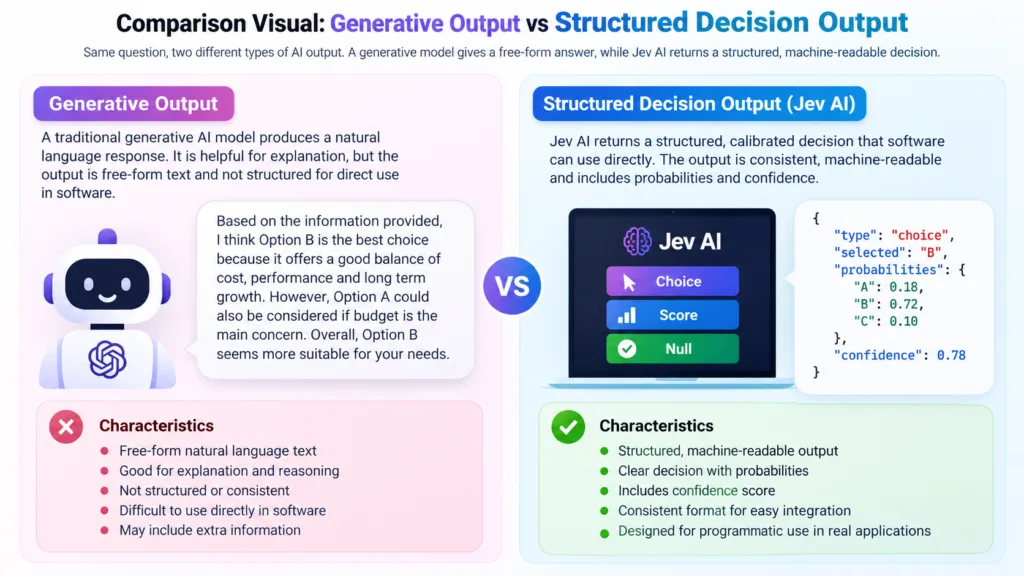
Key takeaway: Jev AI is not a chatbot. It does not generate prose, code or explanations. It returns one of a predefined set of choices, a score on an ordered scale, or a yes/no probability, always with a confidence value that software can threshold on.
Why Developers Are Looking Beyond Text-Generating AI
If you have ever built a production system that relies on a language model to classify, route or score something, you know the drill. Write a prompt, ask for JSON, tell the model to be concise, and get a paragraph back anyway. Add a retry, then a validation step, then another retry when that fails too. Log the failures, build a dashboard to watch them pile up. And underneath all of that, you are still paying for tokens that generate the reasoning behind the answer, even though your application only ever needed the answer itself.
The core engineering problem is not that language models are bad at classification. They are often quite good at it. The problem is that their output format is prose, and prose requires interpretation. A model might return “billing” on one call and “Billing department” on the next. It might return an empty string, a JSON object, a Markdown table, or a small essay explaining why it chose billing over technical. Your application code then has to handle every possible variation. That is a lot of defensive programming for what should be a simple decision.
There is also a subtler problem. When a model generates text, uncertainty is hidden. It might write “This is definitely a billing issue” with the same confidence whether it is 95% sure or 55% sure. You do not get a number you can threshold on. You do not get a probability distribution across the possible answers. You get a string, and you are left guessing how much to trust it. If you are routing a high-value enterprise ticket or deciding whether to block a suspicious login, that distinction matters. For background on how these trade-offs play out across different types of AI systems, how AI tools actually work behind the screen is a useful reference.
Jev’s proposition is straightforward: you define the answer space, send it your application state, and get back a typed answer with a probability attached. There is nothing to parse, nothing to validate against a schema you hoped the model would follow, and nothing to retry because the model decided to include a preamble. The output is always one of your options, a number on your scale, or a probability between zero and one.
How the Jev AI Decision Model Works
The request and response flow is simpler than a chat completion. Here is the sequence:
Application State
Ticket text, customer data, JSON objects or plain strings
Typed Questions
Choice, Score or Null with defined criteria
JEV AI
Single parallel pass, no text generation
Structured Result
Typed answer plus probability distribution
Application Logic
Route, prioritise, gate, or escalate
The critical distinction is between what the model outputs and what your application does with that output. Jev does not decide whether to refund a customer or block a login. It returns a probability. Your code decides what probability threshold is acceptable for which action. This separation is deliberate and is one of the more thoughtful aspects of the design. A probabilistic signal should not directly authorise an irreversible operation. It should inform a decision that your application logic controls.
The model runs all questions in a single request in parallel. Adding a second or third question barely changes the response time and costs only the tokens for the extra question text, which are cheap because input pricing is low and output is free[reference:5]. This makes it practical to ask several independent questions about the same piece of state, for example whether a ticket is a bug, which team should own it, and how urgent it is, all in one call.
Terminology Panel
Understand the key concepts behind Jev AI and its decision-making model.
System One Model
A class of AI models designed for fast, structured decisions that software can consume directly. Named after Kahneman’s System 1 thinking, Jev is TypeSafe’s first public System One model.
State
The context you send to Jev. It can be a string, a JSON object, or an array of text. The model evaluates questions against this shared state.
Primitive
One of Jev’s three query types: Choice, Score, or Null. Each maps to a different shape of decision.
Calibration
The property that when the model says 0.8, it is correct about 80% of the time on average across many answers. Calibration is a statistical property, not a guarantee for any single decision.
RLD
Reinforcement Learning for Calibrated Decisions, TypeSafe’s training approach. It differs from RLHF and RLVR by optimising for reliable behaviour inside a program loop rather than human preference or verifiable reward alone. [reference: 6]
Understanding Jev AI’s Decision Types
Jev supports three question types, which TypeSafe calls primitives. Each one covers a different shape of decision, and they can be combined in a single request.
Choice
A Choice question asks the model to pick one option from a set you define. You supply the options and, optionally, criteria that describe what each option means. The model returns the selected key, a probability for every option, and an overall confidence value[reference:7]. This is the primitive you reach for when the decision is a routing or classification problem: which department owns this ticket, which intent does this message match, which category does this document belong to. Choice supports up to 255 options, which is far more than most routing tables need[reference:8].
A realistic example would be a customer support platform that wants to route incoming messages to one of five teams: billing, technical, account, sales, or general. You define those five labels with short criteria descriptions, send the ticket text as state, and get back a selected label with probabilities for all five. Your application then routes the ticket to the selected team. If the top probability is below a threshold you set, you can send it to a human review queue instead.
What can go wrong? The most common failure is poorly designed categories. If two options overlap in meaning, the model has to guess which one you intended, and its probability distribution will spread across both. Well-separated categories with clear criteria are essential. A second risk is that the model selects the right category for the wrong reason, which is hard to detect without labelled evaluation data. This is not a reason to avoid the primitive. It is a reason to test it properly before trusting it in production.
Score
A Score question places the input on an ordered scale that you define. You supply the levels, for example “can wait”, “this week” or “blocking revenue right now”. The model returns a probability-weighted position that can land between two levels, along with the probability distribution across levels and a confidence value[reference:9]. This is useful when the decision is not a discrete category but a degree of something: urgency, risk, quality, helpfulness, or severity.
Consider a content moderation pipeline that needs to rate the severity of a reported comment on a scale from one to five. A Score question returns a continuous value that your code can threshold. Comments above a certain score go to automatic action. Comments in a middle band go to human review. Comments below the threshold are logged and released. The probability-weighted position gives you more information than a single label would, because it captures the model’s uncertainty about where on the scale the input falls.
The failure mode here is scale design. If your levels are not clearly ordered or if adjacent levels are too similar, the model’s distribution will be flat and the returned score will be close to the boundary between two levels. That is not a model failure; it is a signal that your rubric needs work. The model is telling you it cannot distinguish between your options, which is useful information.
Noul
Noul is TypeSafe’s name for a yes/no question. You ask whether a condition holds, and the model returns the probability that the answer is yes. A value near 0.5 means the model is undecided. A value near zero or one means it is confident[reference:10]. The name is unusual but the primitive is the simplest of the three. It is the one you use for guardrails, safety checks, and binary gates.
A practical example is an AI agent that is about to take an action such as sending an email, making an API call, or executing a trade. Before the action is authorised, a Noul question asks whether the action appears safe given the current state. If the probability of safety is above a high threshold, the action proceeds. If it is below a low threshold, it is blocked. In between, it is escalated for human review. This pattern is sometimes called a decision layer or a guardrail, and it is one of the more compelling use cases for Jev because the output is a number that code can act on directly.
The limitation of Noul is that it is only as good as the question you ask. If your question is vague or your criteria are unclear, the probability will be poorly calibrated and you will not know whether the model is genuinely uncertain or simply confused by your instructions.
Comparison of Jev AI Decision Types
Explore the three decision primitives, the inputs they require, and the outputs they produce.
| Primitive | Question It Answers | What You Supply | What Comes Back | Typical Use |
|---|---|---|---|---|
| Choice | Which one of these options? | Set of labels with optional criteria | Selected key, per-option probabilities, confidence | Routing, classification, intent detection |
| Score | Where on this scale? | Ordered levels or rubric | Weighted position, per-level probabilities, confidence | Urgency, risk, severity, quality scoring |
| Null | Does this condition hold? | Yes/no instruction with criteria | Probability of yes | Guardrails, safety gates, binary checks |
Quick tip: Use Choice to select an option, Score to evaluate a position on a scale, and Null to check whether a condition holds.
A Practical Jev AI Example for Developers
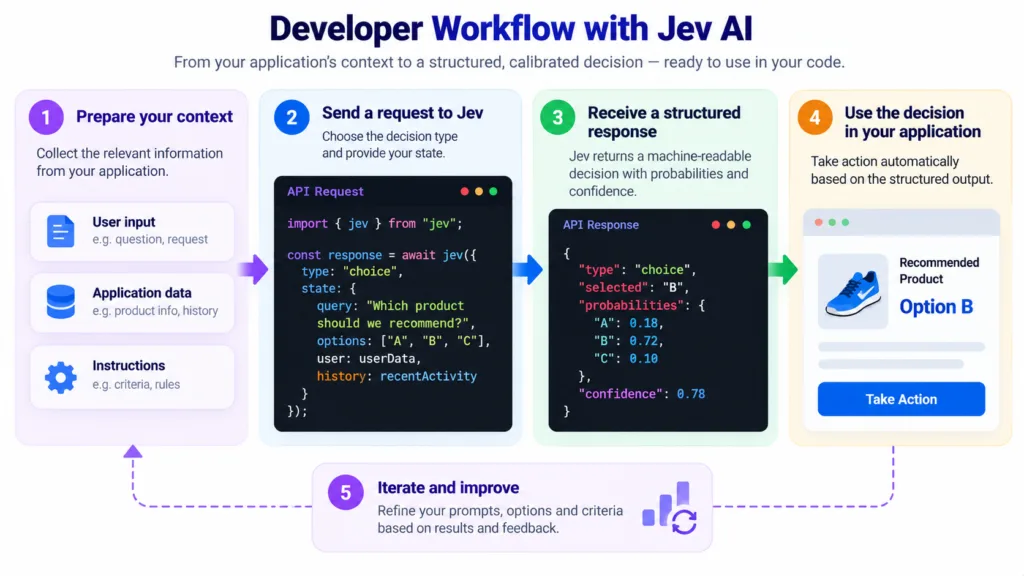
Let us walk through a realistic support-ticket classification scenario using the TypeSafe System One API. The endpoint is POST https://api.typesafe.ai/v1/systemone, and the request body contains three fields: the model identifier, the state, and the questions[reference:11]. The example below is illustrative and follows the documented request shape. It is not a captured API response.
The state is the ticket text, optionally accompanied by structured context such as the customer tier. The questions object defines three decisions in one call: whether the ticket reports a software defect, which team should own it, and how urgent it is.
// Illustrative request following the documented TypeSafe System One API shape
POST https://api.typesafe.ai/v1/systemone
Authorization: Bearer $TYPESAFE_API_KEY
Content-Type: application/json

{
  "model": "jev-latest",
  "state": {
    "customer_tier": "enterprise",
    "ticket": "My checkout page shows a blank screen after I click Pay. I have tried two browsers. This is costing us orders right now."
  },
  "questions": {
    "is_bug": {
      "type": "noul",
      "instructions": "Is the customer reporting a software defect?",
      "criteria": {
        "true": "The customer describes broken or unexpected product behaviour.",
        "false": "The customer is asking a question or requesting a feature."
      }
    },
    "team": {
      "type": "choice",
      "instructions": "Which team should own this ticket?",
      "criteria": {
        "payments": "Checkout, billing, or payment processing issues.",
        "frontend": "Rendering, layout, or browser compatibility issues.",
        "account": "Login, permissions, or profile issues."
      }
    },
    "urgency": {
      "type": "score",
      "instructions": "How urgent is this ticket?",
      "criteria": [
        "Can wait for the next release",
        "Should be fixed this week",
        "Blocking revenue right now"
      ]
    }
  }
}
The response contains a typed answer for each question. The structure follows the question definitions: the Noul returns a probability between zero and one, the Choice returns a selected key plus a probability distribution, and the Score returns a weighted position plus its distribution. Your application code consumes these values directly. It does not parse prose. It does not validate against a schema that the model might have violated. The shape is guaranteed because you defined it.
Here is how the application logic might consume the result. In this illustrative pseudocode, the routing decision is separate from the model’s output. The model returns probabilities; the code applies thresholds.
# Illustrative application logic consuming a Jev response
def route_ticket(jev_response):
    is_bug_prob = jev_response["is_bug"]["noul"]
    team = jev_response["team"]["choice"]
    team_confidence = jev_response["team"]["confidence"]
    urgency_score = jev_response["urgency"]["score"]

    # Route based on the chosen team, but only if confidence is high enough
    if team_confidence >= 0.85:
        assigned_team = team
    else:
        assigned_team = "human_review"

    # Flag as a potential bug if the probability exceeds a threshold
    is_bug = is_bug_prob >= 0.7

    # Escalate if urgency score is in the top band
    escalate = urgency_score >= 2.5

    return {
        "team": assigned_team,
        "is_bug": is_bug,
        "escalate": escalate
    }
This separation is the whole point. The model makes a probabilistic judgment. Your code makes a business decision. If the model’s confidence is low, your code routes to a human. If the model’s probability of a bug is high, your code flags it. The thresholds are yours to set and yours to tune. For a deeper look at how this kind of automation fits into broader workflows, practical AI automation with Zapier covers similar ground for no-code and low-code contexts.
Integrating Jev AI Into an Application
Integration follows a predictable pattern. You obtain an API key, construct a request with your state and questions, send it to the endpoint, and handle the structured response. The details matter more than the outline.
Official SDKs are available for Python and TypeScript. The Python SDK is published as typesafe-sdk on PyPI, and the JavaScript/TypeScript SDK is available as @typesafe-ai/sdk on npm[reference:12]. Both provide typed clients for constructing questions and consuming responses. There are also community SDKs for Go, Elixir, and other languages, as well as integrations with LangChain, LiteLLM, Vercel AI SDK, Pydantic AI Gateway, and Spring AI[reference:13].
Input validation
Before you send anything to Jev, validate that your state is within the supported limits. The context length is 32,000 tokens, and the state plus the longest question should not exceed that budget[reference:14]. If you are sending structured JSON as state, make sure it serialises cleanly. If you are sending raw text, strip anything that is not relevant to the decision. A cleaner state produces a more reliable answer.
Error handling and retries
Even though Jev does not generate text, it can still fail. Network timeouts happen. Rate limits apply. The API may return an error if the request is malformed or if the service is temporarily unavailable. Your integration should handle these cases gracefully. A single retry with exponential backoff is usually sufficient for transient network issues. For rate limits, respect the published limits: 250,000 tokens per second and 1,200 requests per minute per the official documentation[reference:15].
Logging and monitoring
Log every decision request and response, including the state (hashed or redacted if it contains sensitive data), the questions, the returned answers, the probabilities, and the latency. This data is essential for evaluation and debugging. If a routing decision turns out to be wrong, you need to be able to trace it back to the input that produced it. Monitor the distribution of returned probabilities over time. A shift in the distribution can indicate that the model is drifting or that the input data has changed in a way that affects the model’s behaviour.
Version changes
Pin your model version. The documented version is jev-1.13.0, with jev-latest and jev-preview as aliases[reference:16]. Using an alias means you automatically get newer versions, which may change behaviour. For production systems, pin to a specific version and upgrade deliberately after testing. The early SDK releases have already introduced breaking changes to question types, so treat version upgrades as potentially breaking changes[reference:17].
Real-World Use Cases for Jev AI
The use cases for a decision model are defined by the shape of the problem, not the industry. Anywhere software needs to make a bounded choice based on unstructured input, a decision model can fit. Here are some of the patterns that developers are exploring.
Customer support routing
A support platform receives thousands of tickets. Each ticket needs to go to the right team, be tagged as a bug or a question, and be prioritised. A Choice question handles the routing, a Noul question flags bugs, and a Score question handles urgency. The model returns all three in one call. The application routes based on the chosen team and applies thresholds for escalation. The safeguard is a confidence threshold: if the model is not confident enough, the ticket goes to a human triage queue.
Content moderation
User-generated content needs to be reviewed for policy violations. A Score question rates severity on a scale. A Noul question asks whether the content violates a specific policy. The output is a number that code can threshold. High-severity content is actioned automatically. Borderline content goes to human review. The safeguard is calibration testing: you need to verify that the model’s probabilities actually correspond to observed accuracy on your content.
Intent classification
A conversational interface needs to understand what the user wants. A Choice question maps the message to one of a predefined set of intents. The probability distribution tells you how confident the model is and whether the message might span multiple intents. If the top two probabilities are close, you can ask a clarifying question rather than guessing.
Lead prioritisation and risk scoring
A sales or risk pipeline needs to rank incoming leads or applications. A Score question places each one on an ordered scale. The returned score is a continuous value that can be sorted. A Noul question can flag high-risk cases for manual review. The safeguard is a human review step for cases that fall in the middle of the distribution, where the model’s uncertainty is highest.
AI agent routing and guardrails
An AI agent that can take actions needs a way to decide which tool to call and whether an action is safe. A Choice question selects the tool from a catalogue. A Noul question checks whether the action meets safety criteria before it is authorised. This pattern is sometimes called a decision layer, and it is one of the more compelling applications because it addresses a real problem in agentic systems: the gap between what a model can do and what it should be allowed to do. The safeguard is that the decision model’s output is probabilistic, so it should inform a permission check rather than replace it. Irreversible actions should require additional verification.
Data classification and output validation
Large volumes of documents need to be categorised. A Choice question assigns each document to a category. A Noul question checks whether a piece of generated output meets a quality or safety standard. The output is a typed label or a probability that code can act on. The safeguard is regular spot-checking against labelled data to confirm that the model’s accuracy has not degraded.
Across all of these use cases, the pattern is the same. The model provides a bounded, probabilistic decision. The application provides the business logic, the thresholds, and the human oversight. The model is not responsible for the consequences of the decision; the system that uses it is. This division of responsibility is what makes a decision model safe to deploy in production, provided that the system around it is designed with the necessary safeguards.
Jev AI vs ChatGPT, Claude and Other Language Models
The comparison between Jev and a conversational language model is not a contest. They are different tools for different jobs. Jev cannot write a customer reply, summarise a document, or generate code. ChatGPT, Claude, Gemini and other frontier models can. But those models are expensive and slow when all you need is a label. Jev is designed to fill that gap, not to replace the generalists.
The table below compares them across the dimensions that matter for production integration. It is a factual comparison based on documented characteristics, not a benchmark ranking. Performance depends on the specific model versions, the workload, the input size and the evaluation method. No single model wins across all dimensions.
Comparison of Jev AI and Conventional Generative Language Models
A side-by-side comparison of capabilities, output formats, performance, and use cases.
| Dimension | Jev AI (System One) | Conventional LLM (e.g. ChatGPT, Claude, Gemini) |
|---|---|---|
| Primary task | Bounded decisions: classification, routing, scoring, verification | Open-ended generation: conversation, writing, coding, reasoning |
| Free-form text generation | No. Does not produce prose, explanations or reasoning traces | Yes. Core capability |
| Structured decision output | Always typed. One of your predefined options, a score, or a probability | Requires structured output modes; content can still drift |
| Uncertainty representation | Returned as calibrated probability distributions | Usually hidden inside prose; requires separate extraction |
| Integration requirements | Dedicated evaluate endpoint or SDK; not the chat completions format | Chat completions or equivalent; widely supported |
| Explainability | Limited. Returns a decision and a probability, not a rationale | Can generate a rationale, though its faithfulness is not guaranteed |
| Latency | Reported 70 to 500 milliseconds end-to-end for suitable workloads | Seconds to tens of seconds, depending on model and output length |
| Cost model | Per input token, output free | Usually per input and output token; output often costs more |
| Appropriate workloads | High-volume, low-complexity decisions inside software | Complex reasoning, generation, multi-step tasks |
Key distinction: Jev AI is designed for bounded, structured decisions, while conventional LLMs are designed for open-ended language generation.
If you are working with multiple language models and want a structured way to compare their capabilities for a specific workflow, the complete ChatGPT guide and the Google Gemini explainer cover the practical differences between the major generalist models. For developers who are already using GitHub Copilot or Cursor AI in their workflow, the pattern is familiar: specialised tools for specialised tasks, with a generalist available when the task requires it.
Independent benchmarks have started to emerge. One comparison found that Jev matched Claude Opus 5 on a held-out hallucination detection task at approximately one three-hundredth of the cost and twenty-three times the speed, though both models reached the same accuracy figure[reference:18]. Another benchmark on Reddit AITA verdicts placed Jev second behind a Claude model on Brier score, while noting that Jev’s median call was 6.3 times faster and 62 times cheaper[reference:19]. A third comparison on rubric-based classification reported Jev as more accurate and substantially cheaper than two Claude models on the core task[reference:20]. These results are encouraging but they are workload-specific. They do not mean Jev is better than Claude in general. They mean that on specific classification tasks, a specialised decision model can be competitive while being much cheaper and faster.
Jev AI Pricing and Running Costs
TypeSafe prices Jev at $0.042 per million input tokens, with output tokens free[reference:21]. That is the verified official price as of late September 2026. New users receive $5 in credit on registration, which is approximately 120 million tokens at the input rate[reference:22]. The pricing model is unusual because output is free. For a model that does not generate text, there is no output to charge for. The cost of a request is determined entirely by the size of the state and the questions you send.
Here is a calculation based on the official price. If a support ticket and its associated questions total 500 tokens, one decision costs approximately $0.000021. At 10,000 tickets per day, that is roughly $0.21 per day, or about $6.30 per month. At 100,000 tickets per day, it is approximately $2.10 per day, or $63 per month. These figures are estimates based on the stated input price and a representative token count. Your actual token usage will depend on the length of your state and the number of questions you ask.
Illustrative Monthly Cost Comparison
Estimated cost for 100,000 decisions per day
Hypothetical workload. Assumes 500 input tokens per decision and the published input-only price for Jev. LLM cost estimates are illustrative and vary widely by model and output length. These figures are not benchmark results.
The savings in this hypothetical are significant, but they depend on the workload. If your decision requires a long state, the input cost rises proportionally. If your decision requires reasoning that Jev cannot provide, you still need a generative model. The comparison is most relevant when the workload is high-volume and the decisions are bounded. For low-volume or complex decisions, the cost difference may not justify the integration effort.
Before committing to a deployment, check the current pricing on the TypeSafe model page or the OpenRouter model page, as prices may change. Also check the rate limits and the free credit terms, which may be adjusted. The pricing advantage is real, but it is not the only factor. The reliability of the model on your specific workload matters more than the per-token price.
Performance, Probability and Confidence
A probability from Jev is not a guarantee. It is a calibrated estimate. When Jev says 0.8, it means that across many answers of that type, it is correct about 80% of the time[reference:23]. That is what calibration means, and it is a useful property. But it is a statistical property, not a promise about any single decision. A single answer with a probability of 0.99 can still be wrong. A single answer with a probability of 0.51 can still be right.
For developers, this has practical implications. If you set a threshold of 0.9 for automatic routing, you are accepting that approximately 10% of the decisions above that threshold may be wrong, on average. If that error rate is acceptable for your use case, the threshold is appropriate. If it is not, you need a higher threshold, a human review step, or a different approach entirely. The probability is a signal, not a verdict.
Calibration can shift. If the distribution of inputs changes, the model’s probabilities may no longer correspond to observed accuracy. This is distribution shift, and it is one of the reasons you should monitor the model’s performance over time. A model that is well calibrated on last quarter’s data may be poorly calibrated on this quarter’s data. The only way to know is to measure.
There is also a distinction between the model’s reported confidence and your application’s accuracy. Jev might return a confidence of 0.95 for a choice, but if your categories are poorly defined or your state is noisy, the observed accuracy might be much lower. Confidence is an internal signal. Accuracy is an external measurement. Never confuse the two. If you want to understand how different AI systems handle uncertainty, the comparison between Claude Fable 5.1 and other models is instructive, though the approaches differ fundamentally.
Limitations Developers Should Understand
TypeSafe publishes a list of known failure modes for Jev, and these are worth reading before you commit to a deployment[reference:24]. The most important limitations are as follows.
Documented limitations and failure modes
- Fixed answer spaces. Jev can only choose from the options you provide. It cannot invent a new category or a new score level. If your answer space is poorly designed, the model has no way to correct it.
- Literal instruction following. It answers the question you write, not the question you intended to write. Ambiguous or poorly worded instructions produce unreliable decisions.
- Arithmetic and counting. Jev is not a calculator. It does not count reliably and should not be used for numerical computation.
- Date and time comparison. It reads dates as text rather than ordered values. Comparisons involving dates should be handled in code, not by the model.
- Multilingual performance. English is the best-supported language. Accuracy in other languages varies, and long non-English inputs may degrade further.
- Text-only input. Jev does not accept images, audio or video. If your decision depends on visual content, you need a different tool.
- No explanations. Jev returns a decision and a probability. It does not explain why it chose that answer. If you need a rationale, you need a different model or a separate explanation step.
- Calibration is statistical. As discussed above, a probability is not a guarantee for any single decision.
- No generation. Jev cannot produce text, code or any other generative output. That is by design, but it means it cannot replace a generative model.
Beyond the documented limitations, there are production considerations. Prompt injection is a risk. Because Jev processes user-supplied state, a malicious input could attempt to manipulate the decision. The structured output space limits the damage, but it does not eliminate the risk. A Noul question about safety can be part of the defence, but it should not be the only defence. Deterministic business rules and permission checks should still govern sensitive operations. For a broader perspective on the security considerations around AI agents and tools, the discussion of AI browser assistants touches on similar themes.
Sensitive data handling is another concern. TypeSafe states that inputs are not used for training, and Jev supports Zero Data Retention on a per-request basis through some gateways[reference:25]. However, third-party security certifications and enterprise management features were not confirmed at the time of writing. If your workload involves regulated data, verify the current compliance posture directly with TypeSafe before deployment.
How to Evaluate Jev AI Before Production
Do not deploy Jev on the strength of a demo. Evaluate it on your own data, with your own labels, against your own baselines. Here is a practical evaluation plan.
Production Readiness Checklist
Validate performance, reliability, security and cost before deploying your AI decision system in production.
Before you deploy: Work through each item and verify it against your actual workload. Tick the boxes as you complete each check.
Data & Evaluation
Establish a reliable performance baseline.
Performance & Cost
Understand speed, usage and operational efficiency.
Robustness & Security
Check how the system handles unexpected inputs.
Monitoring & Deployment
Keep track of system behaviour after launch.
Ready for production?
Complete all 11 checks to finish your readiness review.
The goal of this evaluation is not to prove that Jev works. It is to discover whether it works well enough for your specific workload, at your specific thresholds, with your specific data. If it does not, that is a valid result. A decision model is not appropriate for every problem. The evaluation will tell you where the boundaries are.
Building a Hybrid AI Architecture With Jev AI
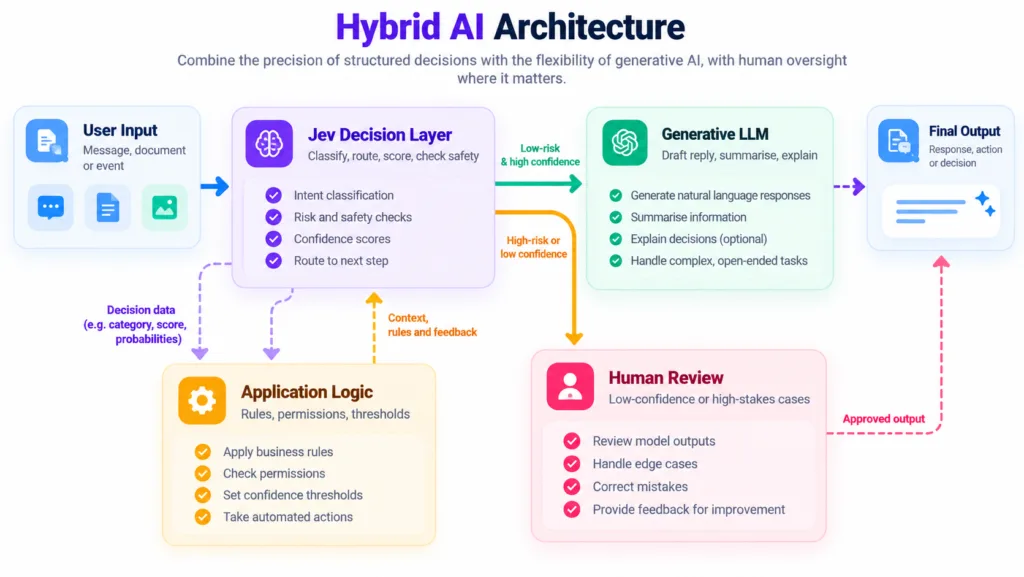
The most interesting architectural pattern is not Jev instead of a language model. It is Jev alongside a language model, with each component doing what it is best at. A generative model handles the language. A decision model handles the routing and the guardrails. Application code handles the business rules and the irreversible actions. A human handles the cases where the system is uncertain.
How Jev AI Fits into an Application
A structured decision layer working alongside application logic, generative AI and human oversight.
User Input
Message, document or event
Jev Decision Layer
Classify, route, score, check safety
Application Logic
Rules, permissions, thresholds
Generative LLM
Draft reply, summarise, explain
Human Review
Low-confidence or high-stakes cases
In this architecture, the decision model is the first thing that touches the input. It classifies the request, scores the risk, and selects the route. The application logic then applies the business rules. If the decision is confident and the action is low-risk, the system proceeds automatically. If the decision is uncertain or the action is sensitive, the system escalates. The generative model is used for the parts of the workflow that require language: drafting a reply, summarising a document, explaining a decision to a user. The human review step is the final backstop for cases that fall outside the system’s confidence envelope.
The most important architectural principle is that a probabilistic decision should not authorise an irreversible action. Jev can recommend a refund, but the refund should require an additional confirmation step. Jev can flag a login as suspicious, but the blocking action should be governed by a policy that the application enforces. The model informs the decision. The system makes it. For more on this pattern, the discussion of n8n AI automation covers how decision layers fit into workflow orchestration, and Amazon Bedrock provides infrastructure for deploying these hybrid systems at scale.
The Future of Decision-Focused AI
Jev is an early example of a category that may grow. The separation of language generation from machine-consumable decisions is a natural architectural split, and it maps cleanly onto the way software systems are already structured. Your application does not need a language model to decide which queue a ticket belongs to. It needs a classifier. Your application does not need a language model to check whether an action is safe. It needs a policy check with a probability. The generalist models are remarkable, but they are not the right tool for every job.
If this pattern takes hold, expect more specialised models occupying narrow niches in the software stack: one that only classifies, one that only scores, one that only validates. Each is cheap, fast, predictable, and has a narrow interface that code can consume directly. The generalist model remains for the tasks that actually require it, but it stops being the first thing every request touches. The decision layer becomes the first line of processing, and the language model gets called only when language is actually needed.
There are open questions. How do you evaluate a decision model when its output is a probability rather than a string? How do you monitor for drift when the model’s behaviour is bounded but its calibration may shift? How do you compose multiple decision models into a coherent pipeline? These are engineering problems without established answers, and the tools for solving them are still being built. The document intelligence platforms that are emerging in the same space face similar challenges: how to make AI outputs reliable enough to trust in production systems.
The broader AI ecosystem is moving the same way. Microsoft Copilot is folding decision-making into productivity tools, and Notion AI and Jasper AI are embedding it into content workflows where decisions about structure and tone matter as much as the generated text itself. As these systems mature, where the decision layer sits in the stack is becoming a real design question rather than an afterthought.
For developers, the practical takeaway is not that Jev replaces ChatGPT or Claude. It is that the decision layer is a distinct architectural component worth considering on its own terms. When designing a system that uses AI, ask which parts of the workflow require language and which parts require a decision. Language belongs to a generative model; decisions belong to something that returns a typed answer with a probability. Keeping those concerns separate makes the system easier to reason about, test and operate. Tools like content creation AI, voice generation platforms and video generation tools are largely about what happens after the decision is made. The decision itself is a separate problem, worth solving with something built for it.
The same split shows up elsewhere in AI tooling, even where it is not labelled as such. AI in SEO is really a set of decisions about content structure and keyword targeting. Perplexity AI decides which sources to cite. AI tools for students decide how to summarise and organise information. The decision layer is distinct from the generation layer in each case, whether or not the user ever sees it. A specialised model like Jev just makes that layer explicit.
A broader creative ecosystem sits alongside decision models, addressing a different part of the workflow entirely: Midjourney AI and Flux AI for image generation, Seedance 2.0 and Higgsfield AI for video, Synthesia AI for avatar-based video, Canva AI for design. These are generative tools rather than decision tools, but the same architectural question applies to all of them: where does the decision end and the generation begin? The Replit AI guide covers the developer workflow side of that question, and the Amazon AI tools overview covers the infrastructure side.
A few newer tools blur the line between decision and generation outright. Muse Spark 1.3 and Shoomble AI are experimenting with different interfaces for AI-assisted work, and Microduck Robot AI is poking at the boundary between physical and software agents. It is too early to say which of these patterns stick, but they are all circling the same question: how do you make AI outputs reliable enough to trust in production? Jev is one answer. Probably not the only one, but a useful one.
Decisions as Infrastructure: What Changes When Software Thinks in Probabilities
The most interesting thing about Jev AI is not its speed or its price, though both are remarkable. It is the interface. It treats a decision as a first-class output type, with a defined answer space, a probability distribution and a confidence value. That is a different way of thinking about what an AI model produces. For most of the past few years, the dominant metaphor has been the assistant. You ask a question, you get an answer. The answer is prose, and you interpret it.
Jev inverts that metaphor. The model is not an assistant. It is a component. It does not answer questions in a conversational sense. It returns values that code can branch on, sort by and threshold against. That shift from assistant to component changes how you design systems. You stop asking “how do I get the model to return the right format?” and start asking “what is the right decision to make here, and what is my tolerance for error?” The model stops being the source of truth and becomes a signal inside a larger system, one where your application logic is the source of truth, your thresholds are the policy, and your human review process is the backstop.
That is a healthier architecture: the probabilistic component stays in its proper place, and the deterministic components stay in theirs. It also makes the model’s limitations explicit instead of hiding them behind a confident-sounding paragraph. A probability of 0.6 is a different thing from a sentence that says “I am confident that this is a billing issue.” The number tells you something the sentence conceals.
There are still questions to answer. How do you compose multiple decision models without creating a new kind of fragility? How do you evaluate a model whose output is a distribution rather than a string? How do you audit a decision that was made by a system that cannot explain itself? These are not solved problems. But they are the right problems to be working on. The alternative, prompting a language model to classify something and hoping the JSON parses, is a problem that has been solved in the wrong direction for too long.
Jev is not the only tool in this space, and it will not be the last. But it makes a clear argument: the decision layer deserves to be its own component, with its own interface and its own evaluation criteria. Whether you use Jev or something else, that argument is worth taking seriously. The next generation of production AI systems will be judged not by how well they generate text, but by how reliably they make the small, frequent decisions that keep software running.
Research and verification note: Product specifications, pricing and capabilities described in this article are based on TypeSafe AI’s official documentation, the OpenRouter documentation hub for Jev, the TypeSafe System One API reference, and independent developer reporting from September 2026. Where the article describes illustrative code or hypothetical workloads, this is clearly labelled. Benchmarks from third parties are attributed to their source and should not be treated as general performance claims. Pricing and rate limits may change; verify current figures before deployment.