

Most people who start using AI voice generation do not have a script problem. They have a voice problem. The script is done, the video is edited, the podcast outline is ready, but the actual recorded voice sounds flat, the microphone picks up the neighbour’s dog, and the third retake makes everything feel worse. That is exactly the point where ElevenLabs AI becomes interesting, not because it removes the human, but because it changes where human effort goes.
ElevenLabs AI sits somewhere between a raw text to speech engine and a full audio production suite. If you have used browser based TTS tools before, the difference is immediately obvious: those tools sound like machines that learned to read. ElevenLabs AI often sounds like a person who knows what they are reading, with pauses, emphasis and tone that do not feel forced. That does not mean it is perfect. It means the starting point is much higher.
What ElevenLabs AI Actually Does
At its core, ElevenLabs AI converts written text into spoken audio. That sounds basic, but the platform layers multiple capabilities on top of that conversion. You can use existing voices, clone a voice from a short sample, design a completely synthetic voice, generate speech in multiple languages, and access the same functionality through an API for developer workflows.
The first thing that surprised me was not the voice quality itself but how little audio you need to get a usable clone. A clean recording of under a minute can produce something recognisable, although the best results come from longer, cleaner, well-articulated samples. Under the hood this is speech representation learning combined with fine tuning on speaker characteristics.
The platform earned its reputation in the AI voice generation space by optimising for naturalness early. Many competitors still produce clear but flat audio. ElevenLabs AI carries more emotional variation, and that matters for narration and storytelling in particular, where a short attention span punishes anything that sounds flat.
Why ElevenLabs AI Is Different From Basic Text-to-Speech
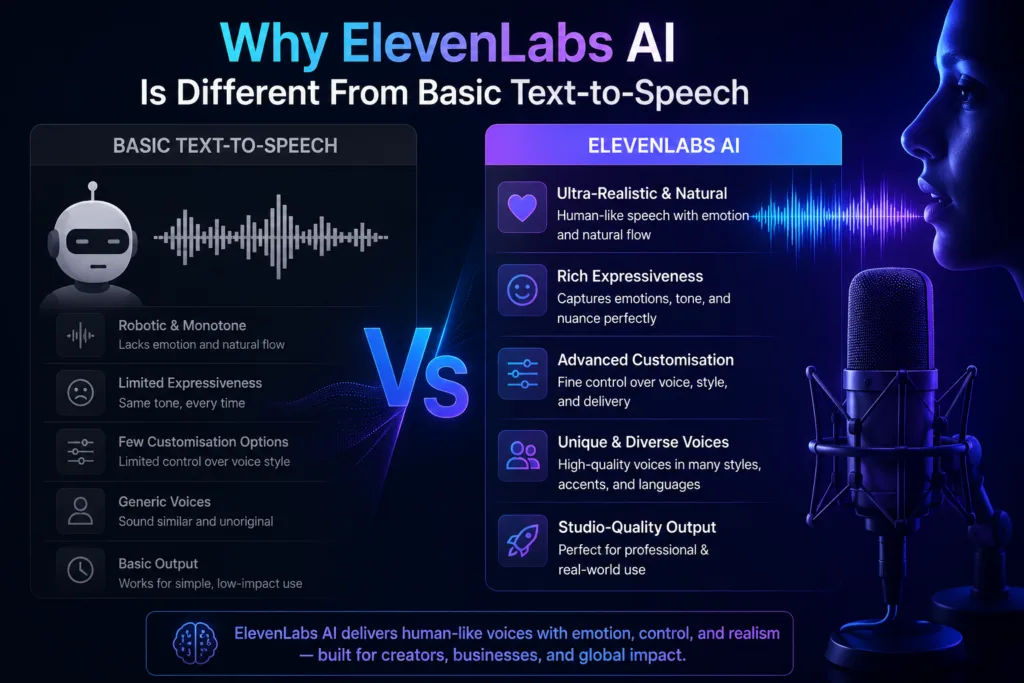
Basic text to speech systems rely on concatenative or older parametric methods. They assemble sounds from fixed units and often produce robotic, monotone output. ElevenLabs AI uses a generative approach that models speech patterns more holistically, which shows up in better rhythm, intonation and handling of long passages, not just cleaner pronunciation.
From a developer’s perspective, the difference matters because basic TTS often fails on long form content. It drifts, loses pacing, or sounds repetitive. ElevenLabs AI holds voice quality and voice consistency across thousands of words, which is essential for audiobooks and long YouTube voiceovers. That is not to say it never drifts, but the failure mode is less obvious.
Another difference is the voice cloning and voice design layer. Most TTS tools offer a fixed set of voices. ElevenLabs AI allows custom voices, which changes how content teams operate. Instead of choosing from five generic voices, a team can create a consistent brand voice and reuse it across every episode or campaign.
How ElevenLabs AI Works at a High Level
Under the hood, ElevenLabs AI uses deep learning models trained on large amounts of speech data. The system learns patterns in how humans speak, including pauses, emphasis, breathing and pronunciation. When you provide text, the model predicts a sequence of acoustic features that are then converted into audio.
The interesting part is voice conditioning. For voice cloning, the model receives a reference audio sample and extracts a speaker embedding, a compact representation of that person’s vocal characteristics. The text to speech engine then uses this embedding to generate new speech in the same voice. This is why a short sample works: the model does not need to memorise every word, it only needs to understand the vocal fingerprint.
For voice design, the platform can generate entirely new voice profiles. You might set parameters for age, gender, accent, tone and speaking style, or let the system create variations. This is useful for fictional characters, brand voices or when you do not have a human voice actor available.
Multilingual voice generation is another important layer. The model can often preserve a speaker’s voice while switching languages. This is not perfect across every language pair, but for major European and Asian languages it is genuinely impressive. For localisation workflows, this capability reduces the need to hire separate voice actors for every market.
Voice Cloning Explained
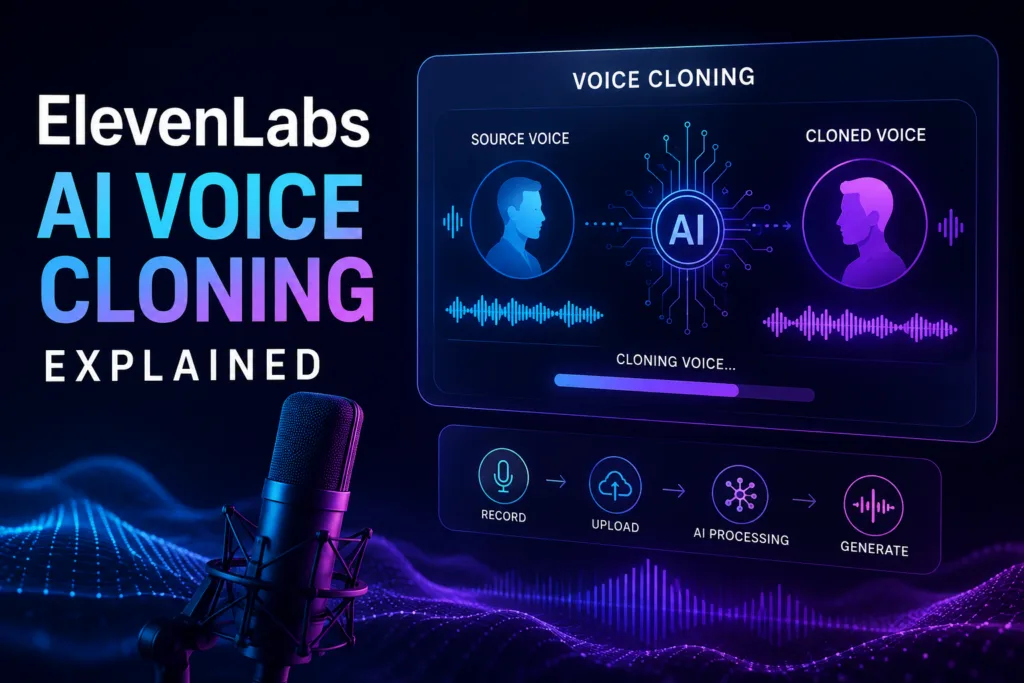
Voice cloning in ElevenLabs AI is the process of creating a digital copy of a specific voice. You upload a clean audio sample, the system analyses the voice characteristics, and you can then generate new speech in that voice. The quality depends heavily on the input sample. Background noise, inconsistent microphone placement and emotional variation all affect the output.
I would use this when I need to produce regular content with the same voice but cannot record every time. A podcast host who travels, a course creator who updates modules frequently, or a YouTuber who needs quick corrections without re-recording full episodes can all benefit. The trade off is that the cloned voice may miss the spontaneous energy of a live recording, especially in emotionally charged moments.
The consent side is worth dwelling on. ElevenLabs AI has implemented voice verification and usage policies, but the responsibility still sits with the person creating the clone. You should never clone a voice you do not have permission to use, and this is not a grey area worth testing.
Warning on voice cloning: Cloning another person’s voice without explicit written consent is unethical and often illegal. Always use your own voice, a licensed voice, or a properly authorised sample. Misuse can lead to account bans, legal action and serious reputational damage.
Voice Design and Character Voices
Voice design is where ElevenLabs AI moves beyond cloning and enters creative territory. Instead of replicating an existing voice, you generate a new one. This is particularly useful for games, animated content, brand mascots and audio dramas. You can iterate through voice variations until you find one that matches the character you have in mind.
From a production perspective, voice design changes the economics. A small animation team no longer needs to hire a voice actor for every minor character. They can generate a voice, direct it through prompts and fine tune the output. Voice actors are far from obsolete, but the baseline for simple background voices has shifted.
If I were building an audio drama, I would use ElevenLabs AI for secondary characters and keep a human voice actor for the lead. The human performance anchors the emotional core, while the synthetic voices fill the world without blowing the budget.
Multilingual Voice Generation and Dubbing
One of the strongest use cases for ElevenLabs AI is multilingual voice generation. Instead of producing an English video and then hiring translators and voice actors for five languages, a creator can generate the same voice speaking multiple languages. The voice quality is not identical across every language, but for many use cases it is good enough to publish.
AI dubbing is a related but more complex workflow. You provide the original audio, the system transcribes it, translates the transcript, and then generates new speech in the target language while trying to match the timing and tone of the original. This is not as polished as professional dubbing, but for educational content, internal training videos and social clips it can work well.
The limitation is nuance. Idioms, humour and cultural references often get lost. A direct translation does not equal a good localisation. I would use ElevenLabs AI dubbing for factual content and quick turnarounds, but I would still involve a human editor for anything emotionally or culturally sensitive.
ElevenLabs AI for Developers
The developer API is where ElevenLabs AI becomes more than a consumer tool. You can integrate text to speech, voice cloning and voice management into your own applications. This matters for content platforms, e-learning systems, customer support automation and any product that needs to generate audio programmatically.
The API follows a REST pattern with authentication via an API key. You submit text along with voice settings and receive audio data in return. The exact endpoints and parameters change over time, so I always recommend checking the current official ElevenLabs documentation before building anything serious.
// Illustrative JavaScript structure for an ElevenLabs AI request // This is NOT the exact current API. Consult the official docs for live endpoints. const voiceRequest = { text: “Welcome to the practical guide to ElevenLabs AI.”, voice: “selected_voice_id”, settings: { stability: 0.5, similarity: 0.75, style: 0.3, use_speaker_boost: true } }; // Conceptual function to send the request async function generateSpeech(req) { const response = await fetch(‘/api/voice/generate’, { method: ‘POST’, headers: { ‘Content-Type’: ‘application/json’, ‘Authorization’: ‘Bearer YOUR_API_KEY’ }, body: JSON.stringify(req) }); const audioBuffer = await response.arrayBuffer(); return audioBuffer; }
The code above is illustrative, not a copy-paste snippet. Real integration requires reading the current documentation, understanding rate limits, handling errors and managing audio file formats. Do not build a production system on guesses.
What makes the API interesting for developers is less the audio generation itself and more the ability to automate voice workflows around it. You can generate hundreds of personalised audio messages, create dynamic podcast feeds, or power an AI voice agent that answers customer queries. It’s a similar pattern to how developers use GitHub Copilot AI for code or Replit AI for rapid prototyping.
ElevenLabs AI Prompting Guide
Prompting is not just for text and image models. With ElevenLabs AI, the way you write the script directly affects the voice output. You are not controlling the model with long natural language prompts in the same way you would with ChatGPT, but you are influencing tone through punctuation, sentence length and explicit direction notes.
It’s surprising how much difference a well placed full stop makes. Short sentences create a more deliberate pace. Longer sentences with commas produce a flowing, conversational rhythm. If you want a dramatic pause, use a line break or an ellipsis. If you want emphasis, capitalise the word, but sparingly.
Here are practical ElevenLabs AI prompts that work for different content types.
YouTube narration prompt
“Start with a slightly faster pace. Sound curious but not overly excited. When you say the main product name, pause briefly before and after. Keep the tone steady until the final sentence, then slow down slightly.”
Documentary narration prompt
“Neutral, calm, authoritative. Speak as if explaining a complex topic to an intelligent friend. Avoid sounding like a newsreader. Use a measured pace. Emphasise key statistics without shouting.”
Podcast intro prompt
“Energetic but relaxed. Imagine you are greeting a regular listener. Smile while speaking. Keep the pitch slightly higher on the word ‘welcome’. End with an upward note to create anticipation.”
Product explainer prompt
“Friendly, professional, clear. Break the explanation into short chunks. Pause after each benefit. Sound genuinely interested in the product, not like you are reading a script.”
Audiobook prompt
“Narrative style with gentle variation between characters. Slow down during descriptive passages. Slight pause before dialogue. Match the emotional tone of the scene without overacting.”
Children’s storytelling prompt
“Warm, playful, expressive. Use a higher pitch for younger characters. Add a small laugh before funny lines. Speak slower than normal. Emphasise onomatopoeic words like ‘whoosh’ or ‘pop’.”
Technical tutorial prompt
“Clear, patient, methodical. Pause after each step. Slightly emphasise function names and key terms. Avoid sounding monotone. Imagine you are helping someone follow along on their screen.”
Dramatic narration prompt
“Low, intense, controlled. Stretch key words. Use a downward inflection at the end of sentences. Leave a breath before the climax. Do not rush the final reveal.”
Calm educational voice prompt
“Soothing, steady, reassuring. Speak at a relaxed pace. Keep pitch consistent. Avoid sharp changes in volume. Sound like a trusted tutor who wants the listener to succeed.”
Multilingual localisation prompt
“Same voice, same emotional tone, different language. Keep the original rhythm where possible. Do not overemphasise accents. Aim for natural native pronunciation in the target language.”
These prompts work because they describe the desired delivery, not just the content. The more specific you are about pace, pitch, emotion and pauses, the more control you have over the output. That said, natural language prompting cannot override platform specific voice settings. Use both together.
Real-World Use Cases
YouTube voiceovers
YouTube creators often need consistent narration across dozens of videos per month. Recording every line manually is slow and inconsistent. ElevenLabs AI can generate a reliable voice track from a script, then the creator edits the audio into their video. The workflow is simple: write script, generate audio, review, import into editor, adjust timing, publish.
The limitation is authenticity. Viewers can sometimes tell when a voice is synthetic, especially on long emotional segments. The best YouTube use cases are explainers, tutorials, listicles and news style content, where the information matters more than the emotional performance.
Podcast production
Podcasts are interesting because the host’s voice is usually the brand. Replacing it with a synthetic voice can damage the relationship with listeners. However, ElevenLabs AI works well for intros, outros, ad reads and segment transitions. You can also use it to clean up mistakes without re-recording an entire episode.
I would not use ElevenLabs AI to fake a host’s voice for a full episode without disclosure. That crosses a trust line. But for production polish and repetitive elements, it is a practical tool.
Audiobooks
Long form narration is where voice consistency matters most. A human narrator can take weeks to record a book. ElevenLabs AI can generate a full audiobook in hours. The quality is not on par with a professional human narrator, especially for dialogue heavy fiction, but for non fiction, technical manuals and self published works it is a viable alternative.
If I were publishing a technical book, I would use ElevenLabs AI for the first pass, then have a human proof listen and note sections where the pacing or emphasis feels off. Those sections can be regenerated with adjusted prompts.
Marketing and advertising
Marketers need short, punchy audio for social ads, product demos and explainer videos. ElevenLabs AI reduces the turnaround from days to minutes. You can test different voice styles quickly and iterate without waiting for a voice actor. This connects directly to the broader discussion around AI in SEO and content strategy, where speed and consistency are becoming competitive advantages.
Education and e-learning
Online courses and training modules often require dozens of short audio clips. ElevenLabs AI can generate clear, consistent narration for each module. Multilingual support also helps localise courses for international students. The main risk is monotony, so varying prompts and voice styles between sections helps keep learners engaged. Students today already use tools like best AI tools for studying, so the context is shifting quickly.
AI agent and voice interface workflows
Voice agents are becoming a natural extension of chatbots. Instead of only text responses, an agent can speak using ElevenLabs AI. This is useful for customer support, booking systems, interactive voice response and accessibility features. The voice quality is high enough that callers may not immediately realise they are speaking to a machine.
The technical piece involves connecting a language model to ElevenLabs AI through the API. The language model generates the text response, and ElevenLabs AI turns that text into speech. This is conceptually similar to how AI browser assistants work, except the output is audio rather than a browser action.
ElevenLabs AI vs Traditional Voiceover
| Dimension | ElevenLabs AI | Traditional Voiceover |
|---|---|---|
| Turnaround time | Minutes to hours | Days to weeks |
| Voice consistency | Very high across sessions | Subject to human variation |
| Emotional nuance | Good but not fully human | Excellent, especially for drama |
| Cost structure | Subscription or usage based | Per project or per word |
| Creative direction | Prompting and regeneration | Live direction and retakes |
| Best for |
Scale, speed, consistency
AI Advantage |
Authenticity, emotion, brand voice |
The table is not a scorecard. It is a decision making aid. If the goal is 200 short form videos a month, the economics look very different from producing one premium documentary. Use the right tool for the job.
Use Case Fit Table
| Use case | ElevenLabs AI fit | Why it works | Human involvement |
|---|---|---|---|
| YouTube explainer | Strong | Fast, consistent, good enough pacing | Script review, tone adjustments |
| Documentary | Moderate | Neutral tone, long form stable | High, emotional direction needed |
| Podcast intro | Strong | Short, repeatable, consistent branding | Low after initial setup |
| Character drama | Weak to moderate | Voice design possible but emotion limited | Very high, often use human voices |
| Customer support voice agent | Strong | Low latency, clear speech | Script and logic design |
Strengths and Limitations of ElevenLabs AI
Strengths are easy to see. The voice quality is among the best of any AI text to speech tool available right now. The API is flexible enough for production use. Voice cloning works with surprisingly little data. Multilingual support is broad. The pricing model allows low volume testing without a huge upfront commitment.
Limitations are equally important. The generated voice can still sound too polished and lose the raw human imperfections that make speech feel alive. Long emotional passages can drift into monotony. Accents may be inconsistent across languages. Voice cloning raises serious ethical and legal concerns that the platform cannot fully police.
Here is where things get practical. I would not use ElevenLabs AI for a grief memoir audiobook. I would use it for a technical manual, a weekly news roundup, or a product update video. The technology is a tool, not a replacement for human performance.
Pro tip: Use a hybrid approach. Generate the base narration with ElevenLabs AI, then record a few human lines for key emotional moments. The contrast often makes the synthetic parts feel more natural because the listener’s ear has a human anchor.
Common Mistakes When Using ElevenLabs AI
- Cloning a voice without permission and assuming it is fine because the tool allows it.
- Using the same voice for every piece of content without variation, which creates audience fatigue.
- Ignoring the script quality. ElevenLabs AI reads what you write. Bad writing still sounds bad.
- Not listening to the full output before publishing. Glitches, mispronunciations and odd pacing still happen.
- Overusing punctuation prompts. Too many ellipses or capitalised words make the output sound unnatural.
- Expecting the AI to understand sarcasm or irony. It often does not, especially in multilingual contexts.
- Assuming the API is stable. Versions change, endpoints change, parameters change. Always check the documentation.
Voice Quality Control Checklist
- Listen to the entire generated audio before publishing.
- Check for mispronounced names, acronyms and technical terms.
- Confirm the tone matches the content’s emotional intent.
- Verify pacing is appropriate for the platform (YouTube vs audiobook).
- Ensure voice consistency across multiple generated segments.
- Confirm you have the rights to use the voice.
- Test the audio on different devices and speakers.
- Compare the output with a human read for emotional resonance.
- Document the prompt settings for reproducibility.
- Have a second person review the audio for unnatural artefacts.
Responsible AI and Voice Cloning
Voice cloning is not a toy. The ability to generate speech that sounds like a specific person has real consequences. Impersonation, fraud, misinformation and harassment are all possible if the technology is misused. ElevenLabs AI has implemented safeguards, but no system is foolproof.
The responsible approach is simple: only clone voices you have explicit permission to use. That includes your own voice, properly licensed voices, voices of consenting actors, and fictional characters created for your own projects. If there is any doubt, do not do it.
Disclosure also matters. If you are using an AI generated voice in public content, consider whether the audience should know. For some content, disclosure builds trust. For others, it may not be legally required, but transparency is often the safer long term choice.
The same questions come up around how AI tools work behind the scenes more generally. Understanding what the technology actually does makes it easier to spot when it’s being misused.
Who Should Use ElevenLabs AI?
Developers building voice enabled applications, content creators producing frequent videos, marketing teams needing quick audio assets, educators creating online courses, podcasters looking for production polish, and businesses exploring voice agents will all find value. The platform is mature enough for production use but flexible enough for experimentation.
If you already use tools like Cursor AI or Continua AI in your workflow, adding ElevenLabs AI is a natural step toward a full generative content stack.
Who Should Avoid ElevenLabs AI?
If your content depends on raw human emotion, spontaneity and imperfect authenticity, synthetic voice may work against you. A personal essay podcast, a grief memoir, a stand up comedy album, a deeply personal brand video: these formats thrive on human vulnerability. A synthetic voice, no matter how good, will often feel slightly off.
Also avoid ElevenLabs AI if you are not willing to invest time in quality control. The tool is not fully autonomous. It requires scripting, prompting, listening, adjusting and regenerating. If you want one click perfection, you will be disappointed.
How ElevenLabs AI Fits Into a Modern AI Stack
ElevenLabs AI does not exist in isolation. It sits alongside text generation, image generation, video generation and automation tools. A modern content workflow might use a language model for scripting, Midjourney AI or Flux AI for visuals, Runway AI for video, and ElevenLabs AI for voice. The pieces are starting to fit together.
For developers, the stack might include Amazon Bedrock for model orchestration, Google Gemini for reasoning, and ElevenLabs AI for voice output, all tools that already exist and can be wired together today.
The broader guide to AI tools in 2026 shows how quickly this space is maturing. ElevenLabs AI is one component in a larger shift toward generative media workflows.
Workflow Comparison Bar Chart
This chart is illustrative, not benchmark data. It compares relative workflow time for different voice production approaches.
voiceover
voice
ElevenLabs AI vs Other AI Tools
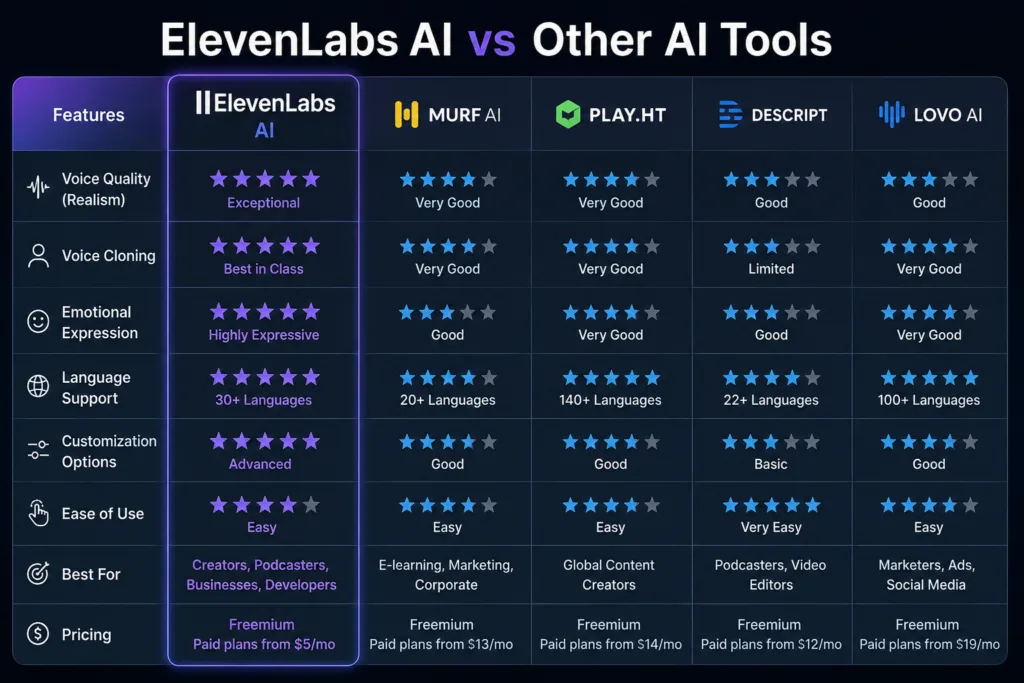
ElevenLabs AI is not the only player in the AI voice generation space, but it has maintained a lead in naturalness and developer adoption. Tools like Synthesia AI focus on video avatars with voice included, while ElevenLabs AI is more specialised on the voice itself. Microsoft Copilot integrates voice in some enterprise scenarios, but it is not a dedicated voice cloning platform. Perplexity AI is a search tool, not a voice tool, but voice interaction is becoming a common interface layer across AI products.
For pure text to speech quality, ElevenLabs AI is a strong default. For video avatars, Synthesia may be better. For enterprise document analysis with audio summaries, Continua AI could be useful. The right choice depends on the workflow.
Practical Workflow: YouTube Video from Script to Voice
Here is a concrete workflow I would use for a technical YouTube video.
- Write the script in plain text, using short sentences and clear punctuation.
- Break the script into sections: intro, main points, examples, outro.
- Choose a voice in ElevenLabs AI that matches the video’s tone.
- Generate each section separately for easier editing.
- Add prompts for pacing and emphasis where needed.
- Listen to the full audio and mark any awkward lines.
- Regenerate problem lines with adjusted prompts or punctuation.
- Import the audio into a video editor like DaVinci Resolve or Premiere.
- Sync audio with visuals, b-roll and screen recordings.
- Publish with a description that includes relevant keywords.
This workflow is not glamorous, but it works. It also keeps the human in control of the final quality check, which is essential.
Prompt Collection for Professional Use
The prompts below are designed for different professional contexts. Each prompt focuses on a specific delivery style.
Corporate training module
“Professional, supportive, clear. Pause between key points. Use a steady pace. Avoid sounding like a salesperson. Emphasise actionable steps.”
News roundup
“Neutral, concise, factual. Match the tone of a public radio host. Slight upward inflection on headline words. Keep energy consistent.”
Explainer for financial products
“Trustworthy, calm, precise. Slow down on numbers and terms. Use a lower pitch for reassurance. Pause before explaining risks.”
App walkthrough
“Friendly, instructive, patient. Imagine guiding someone tap by tap. Slightly emphasise button names. Keep sentences short.”
Company internal announcement
“Warm, clear, confident. Sound like a leader speaking to a team. Avoid corporate jargon. Pause after important changes.”
Workflow Automation with ElevenLabs AI
Once you have a repeatable voice workflow, automation becomes possible. A developer could build a pipeline that takes a blog post, extracts the text, sends it to ElevenLabs AI, generates an audio version, and attaches it to the article. This is how many AI powered content platforms now offer audio versions of written content.
Tools like Notion AI and Jasper AI handle the text side, while ElevenLabs AI handles the audio side. The combination is powerful for content marketing and internal knowledge sharing.
If I were building a content platform today, I would make audio versions standard. ElevenLabs AI makes that economically viable at scale.
Where ElevenLabs AI Goes Next: From Voice Generator to Voice Infrastructure
ElevenLabs AI started as a voice generation tool, but the API, the voice agent support and the multilingual models suggest it is turning into something more like plumbing that other software builds on, rather than a standalone product you open and use directly.
AI agents that talk instead of just typing text back are becoming more common. Browser assistants read answers aloud. Video generators like Runway AI need synchronised voice tracks, and Seedance 2.0 and similar video models are integrating voice more deeply. ElevenLabs AI could end up supplying the voice for a lot of that.
The harder problem is trust. As synthetic voices get harder to tell apart from human ones, clear provenance, watermarking and disclosure matter more, not less. Whichever platforms handle that well are the ones developers and creators will keep relying on.
ElevenLabs AI is not the only player, but it has set a high bar for what AI voice generation can achieve, and it has already made audio production noticeably cheaper for the people using it.
For developers and content teams, the practical takeaway is to try it rather than take my word for it: learn the API, test voice cloning with your own voice, build a small workflow, and see where the quality lands. The only way to understand the trade offs is to use them.
For further context on the broader AI landscape, see Amazon AI tools, Google Gemini explained, and Canva AI. For developer focused comparisons, see Cursor AI and Microsoft Copilot. For AI writing, see Jasper AI. For AI search, see Perplexity AI. For AI video, see Seedance 2.0 review. For AI images, see Flux AI. For AI code, see GitHub Copilot AI. For AI design, see Canva AI. For AI productivity, see Notion AI. For AI browser assistants, see AI browser assistants. For AI in SEO, see AI in SEO. For the ultimate AI tools guide, see the ultimate guide to AI tools. For ChatGPT beginners, see ChatGPT guide. For students, see best AI tools for students. For Amazon AI, see Amazon AI tools. For Amazon Bedrock, see Amazon Bedrock. For Replit AI, see Replit AI. For Synthesia AI, see Synthesia AI. For Continua AI, see Continua AI.