

Jasper AI has been around long enough that it probably doesn’t need a grand introduction. But the tool itself has changed, and so has the AI writing market around it. By 2026, Jasper AI is no longer just a “copywriting assistant” or a ChatGPT wrapper dressed up for marketers. It’s built as a content and marketing workflow platform, aimed specifically at helping teams produce consistent, brand-aware material at scale.
That distinction matters. A generic chatbot can write a decent paragraph. It cannot easily hold your brand voice across a 40-piece campaign, manage content repurposing from one source asset, or give a content team collaborative guardrails. That is the space Jasper AI tries to occupy.
This guide walks through how Jasper AI works in practical terms, which features are actually useful, how it compares with ChatGPT, Gemini, Copilot and other tools, and where it makes sense in a modern content operation. It also covers prompts, workflows, SEO implications, content quality risks, and whether Jasper AI is worth paying for in 2026.
If you are evaluating AI writing tools for a real team, not just testing a demo, the following sections should give you a grounded view.
Developer insight:Jasper AI feels less like a general-purpose language model and more like a content pipeline with a user interface. The core value is context management, brand memory and structured output for marketing tasks. That is a different problem from “generate text on demand”.
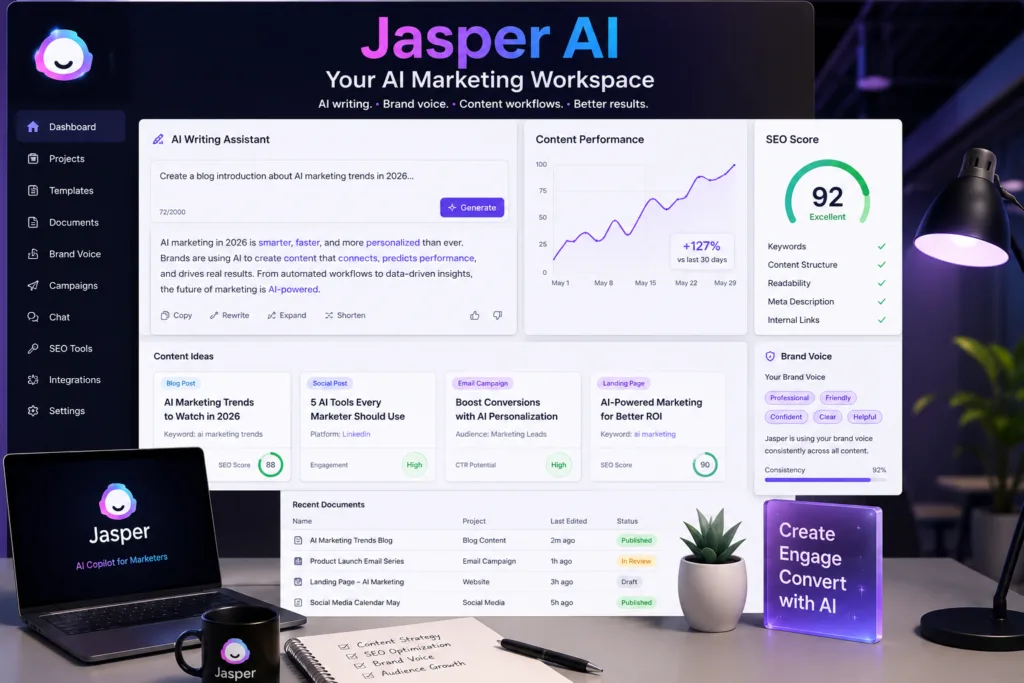
Quick Jasper AI Overview
Jasper AI
A premium overview of Jasper AI’s writing, marketing, SEO, brand voice and workflow capabilities.
| Attribute | Details |
|---|---|
| Tool | CoreJasper AI |
| Category | AI writing, marketing and content workflow platform |
| Primary use | Marketing copy, content creation, brand-aligned writing, campaign assets |
| Target audience | Marketing teams, content teams, agencies, businesses, enterprises |
| Content capabilities | Blog posts, emails, social posts, product descriptions, ads, landing pages, video scripts |
| Marketing capabilities | Campaign workflows, content repurposing, briefs, audience-aware output |
| Brand voice | Central brand voice memory, tone controls, style guides |
| SEO capabilities | Briefs, outlines, semantic coverage suggestions, content optimisation, meta copy |
| Workflow capabilities | Collaboration, team roles, content pipelines, editing, approvals |
| AI model approach | Proprietary orchestration on top of large language models, focused on marketing outputs |
| Best suited for | Teams producing high-volume, brand-consistent marketing and content assets |
What Is Jasper AI?
In the simplest terms, Jasper AI is an AI writing platform built for marketing and content teams. You give it a prompt, select a template or workflow, provide some context about your brand and audience, and it produces copy. That part is not unique.
What makes Jasper AI different is the surrounding system. It stores brand voice, product facts, audience preferences and campaign context. It can repurpose a single long-form asset into multiple smaller pieces. It includes collaborative editing, versioning and approval workflows for teams. From an engineering perspective, you can think of Jasper AI as a content generation layer with persistent memory and structured outputs.
Jasper AI is not a general reasoning engine. It is not the best tool for coding, deep technical research, or open-ended philosophical discussion. If you want a general-purpose AI assistant, ChatGPT or Gemini may serve you better. Jasper AI is more opinionated. It assumes you are creating marketing content, and it optimises for that use case.
Instead of starting from zero every time, Jasper AI lets teams define a “Brand Voice” and reusable context that carries into every future output, so you’re not repeating the same instructions in each prompt. For a team producing 50 pieces a month, that single feature can save a real amount of editing time.
How Jasper AI Works
Jasper AI’s workflow is conceptually straightforward. The user provides input, context, and a desired output. Jasper AI then uses a combination of language models, stored brand knowledge and structured prompting to generate content. You edit, refine, fact-check and publish.
In practice, that sequence looks like this:
- User input: A prompt, brief, or template selection. This could be “Write a landing page for a B2B analytics tool” or “Turn this blog post into three LinkedIn posts”.
- Context injection: Jasper AI pulls from your saved Brand Voice, product facts, tone guidelines, audience notes and any campaign-specific instructions.
- Content generation: The model produces a draft based on the combined input and context.
- Editing and refinement: Users can regenerate sections, rewrite tone, expand points, or use inline editing tools.
- Optimisation: For SEO workflows, Jasper AI can suggest headings, keywords, meta descriptions and semantic coverage.
- Human review: Fact checking, adding original insights, internal linking, and final approval.
Practical tip:Do not treat Jasper AI output as final. The best results come from feeding it a clear brief, reviewing its structure, and then layering your own experience and examples. AI drafting is one step, not the whole workflow.
Jasper AI does not expose raw model configuration to users. You are working with a managed platform, not an API playground. That is fine for marketing teams who do not want to think about temperature or token limits. It is less fine for developers who want fine-grained control. If you need API-level content automation, you may be better off using a direct LLM API with your own context management.
Jasper AI Features
AI Writing and Content Creation
The core feature is AI-generated writing. Jasper AI covers blog posts, landing pages, emails, ad copy, product descriptions, social captions and more. The output tends to be more marketing-aware than raw model output, because Jasper’s prompts and context handling are tuned for commercial writing.
Brand Voice and Memory
Jasper AI allows you to define a Brand Voice that persists across documents. You can include tone, vocabulary, sentence style, audience, positioning and product names. Once configured, Jasper AI applies that context automatically. This is one of the main reasons marketing teams choose Jasper over a generic chatbot.
Marketing Campaign Workflows
Jasper AI can take one campaign brief and generate multiple assets: a blog post, three email variants, five social posts and a landing page section. This is useful when you need consistent messaging across channels without manually rewriting everything.
Templates and Structured Outputs
Jasper AI includes templates for common content types. While not groundbreaking, templates reduce the friction of starting from a blank prompt. They guide the model toward useful structure, especially for teams with less prompting experience.
Content Repurposing
One genuinely useful feature is repurposing. You can take a long-form article and have Jasper AI create a Twitter thread, a newsletter summary, a script for a short video, or a set of social quotes. This fits well with content distribution strategies.
SEO-Oriented Workflows
Jasper AI can generate content briefs, suggest headings based on search intent, help with semantic coverage and create meta descriptions. It is not a replacement for a dedicated SEO tool like Ahrefs or Semrush, but it can handle the writing side of search-optimised content.
Collaboration and Team Controls
Teams can share documents, assign roles, leave comments and manage approvals. For content operations, this is more practical than passing around Google Docs with manually copied AI output.
Developer insight:The collaboration layer is often overlooked. If five people are producing content, you need version history, permission controls and a shared brand memory. That is where Jasper AI behaves more like a CMS plus AI rather than a simple text generator.
Jasper AI for Content Writers
Content writers can use Jasper AI in several realistic ways without losing their voice or authority. The key is to use it for drafting, structuring and repurposing, not for publishing raw output.
Blog posts: Give Jasper AI a topic, audience and outline. It can produce a first draft quickly. You then add your own examples, data, opinions and internal links. For writers who stare at a blank page, this reduces startup cost significantly.
Product descriptions: E-commerce writers can feed Jasper AI product features, benefits and brand voice. It can generate multiple variations for A/B testing or category page copy.
Landing pages: Jasper AI can structure a landing page with headline, subheadings, value props, CTA and supporting copy. The human writer then tightens the messaging and checks for authenticity.
Social media: From a single blog post, Jasper AI can create LinkedIn posts, X threads, Facebook updates and Instagram captions. This is one of the fastest ways to repurpose content without a full rewrite.
Email copy: Subject lines, preview text, body copy and CTA variations. Jasper AI can test different tones and angles. Again, human review is essential to avoid sounding automated.
Ad copy: Short-form performance copy benefits from rapid iteration. Jasper AI can generate 10 ad variants in minutes, which you then test and refine.
Content briefs: Jasper AI can help structure briefs for other writers or freelancers, ensuring consistency across a content programme.
Content repurposing: The most practical use case. Feed one long asset, get five short assets. This expands distribution without multiplying the original effort.
Jasper AI for SEO
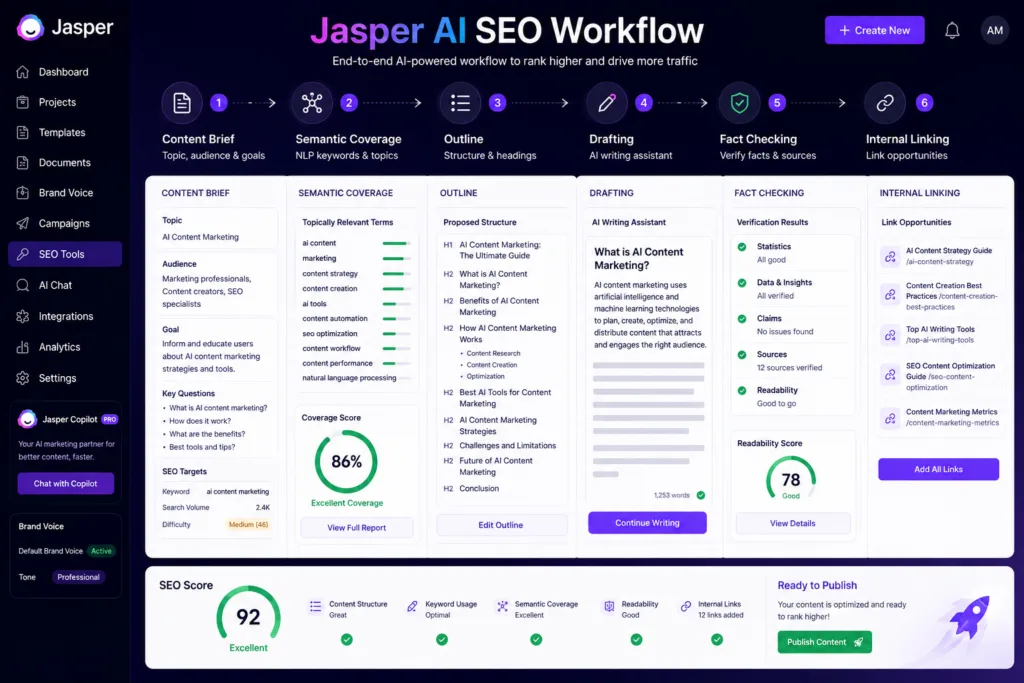
SEO and AI writing can coexist, but only if you are careful. Jasper AI can support an SEO workflow in several ways: search intent analysis, content briefs, semantic coverage, outlines, internal linking prompts and meta copy.
However, AI-generated content alone will not rank well if it lacks original insight, experience and trust signals. Google’s E-E-A-T framework rewards content that demonstrates real experience and authority. A raw AI draft, however polished, often lacks those signals.
Here is a sensible workflow that combines Jasper AI with SEO:
- Identify search intent and primary topic.
- Use Jasper AI to generate a content brief and suggested headings.
- Review the outline against competitor content and your own expertise.
- Draft sections using Jasper AI, but add original examples and data.
- Optimise headings, meta description and internal links.
- Fact-check every claim. Add sources where appropriate.
- Have a human editor review tone, accuracy and brand alignment.
This approach works because the AI handles the structural lifting while the human adds the E-E-A-T layer. For a broader view on integrating AI into SEO, see AI in SEO: How to Build a Modern Content Strategy.
Watch out:Do not publish AI-generated SEO content without human review. Over-optimised, generic content can harm your site’s authority and rankings. Jasper AI helps with the draft, but not with trust.
Jasper AI Brand Voice
Brand voice is probably the strongest reason to choose Jasper AI over a general-purpose chatbot. If you run a company with a defined tone, whether it is playful, professional, technical or bold, you want every piece of copy to sound like you. Jasper AI lets you store that voice and reuse it automatically.
Imagine two versions of the same product description:
Generic AI copy:
“This project management tool helps teams organise tasks and improve productivity. It offers real-time collaboration and advanced reporting.”
Brand-specific copy:
“Stop juggling five tools. Our project workspace brings tasks, docs and reporting into one calm, fast surface built for teams that ship.”
The difference is not just word choice. It is rhythm, tone, audience awareness and confidence. Jasper AI can be trained to lean toward the second style. That is hard to achieve in a general chatbot without repeating the same long prompt every time.
Practical tip:Define your brand voice with concrete examples, not abstract adjectives. Instead of “friendly and professional”, show a sample sentence and explain why it works. Jasper AI learns better from examples than from labels.
Jasper AI Prompts
Prompts are still the primary interface for AI writing. Even with templates and brand memory, the quality of your prompt determines the quality of the output. Below is a practical prompt library covering common Jasper AI use cases. These are not magic spells. They are structured inputs that reduce ambiguity and produce better first drafts.
Blog Writing
You are a senior content strategist writing for a B2B SaaS audience. The brand voice is confident, practical, slightly informal but never sloppy.
Write a 1,200-word blog post on [TOPIC].
Include:
- A strong hook that addresses a specific pain point
- Three practical subheadings
- One real-world analogy
- Short paragraphs
- No fluff, no generic statements
- End with a single actionable takeaway
Audience: [AUDIENCE]
Brand voice: [PASTE BRAND VOICE]
SEO Content Brief
Create a content brief for the keyword: [KEYWORD].
Include:
- Search intent
- Suggested H1
- Three H2s with supporting points
- Questions the article should answer
- Internal linking suggestions
- Meta description draft
- Recommended word count
Base the brief on current search results for this query. Do not invent statistics.
If uncertain, mark items as "needs verification".
Product Description
Write a product description for [PRODUCT NAME].
Key features: [FEATURES]
Target customer: [AUDIENCE]
Desired tone: [TONE]
Length: 120-160 words.
Avoid superlatives like "best" and "amazing".
Focus on outcomes, not just features.
Include a clear CTA.
Landing Page Copy
Generate landing page copy for [OFFER].
Sections: headline, subheadline, three value props, social proof block, CTA.
Tone: [TONE]
Audience: [AUDIENCE]
The headline should be under 10 words and avoid hype.
Each value prop should explain the outcome, not just the feature.
Social Media Thread
Turn this blog post into a 7-post X thread.
First post: a bold, opinionated hook.
Posts 2-6: one key point each, with short sentences.
Last post: a clear CTA to read the full article.
Keep each post under 240 characters.
No hashtag stuffing.
Link to the article in the last post only.
Source: [PASTE ARTICLE]
Email Campaign
Write a 4-email nurture sequence for [PRODUCT/SERVICE].
Goal: [GOAL]
Audience: [AUDIENCE]
Email 1: Problem awareness
Email 2: Solution introduction
Email 3: Social proof and case study
Email 4: Offer and CTA
Each email under 150 words.
Subject lines should be under 45 characters.
Use a conversational but professional tone.
Content Repurposing
Repurpose this long-form article into:
1. A LinkedIn post (180 words)
2. An Instagram caption (100 words, with 5 hashtags)
3. A YouTube script summary (200 words, spoken style)
4. A newsletter intro (120 words)
Keep the core message consistent.
Do not introduce new facts.
Source: [PASTE ARTICLE]
Brand Voice Rewrite
Rewrite the following paragraph in our brand voice.
Brand voice: [PASTE BRAND VOICE]
Original paragraph: [PASTE TEXT]
Do not change the meaning.
Do not add new claims.
Adjust sentence rhythm and vocabulary to match the brand.
Editing and Tightening
Edit this draft for clarity and readability.
Remove redundant phrases.
Shorten sentences where possible.
Keep the author's voice.
Preserve all factual claims.
Draft: [PASTE DRAFT]
Content Refresh
Refresh this old blog post for 2026.
Keep the same core topic.
Update examples, references and language.
Add one new practical insight.
Remove any outdated statistics.
Source: [PASTE OLD POST]
Competitor Analysis Notes
Summarise the content approach of this competitor page.
What topics do they cover?
What is their tone?
What gaps do you notice?
What content angles could we use to differentiate?
Competitor page: [PASTE URL OR CONTENT]
Content Outline
Create a detailed outline for an article on [TOPIC].
Include:
- H1 suggestion
- 5 H2 sections
- 2-3 bullet points per section
- A logical flow from problem to solution
- A section for practical examples
- A section for common mistakes
Do not write the full article, only the outline.
YouTube Script
Write a 5-minute YouTube script about [TOPIC].
Spoken style, natural language.
Include:
- Hook in first 10 seconds
- 3 main points
- One short example or story
- A clear call to action
Format with timestamps.
Avoid marketing clichés.
Ad Copy
Generate 5 ad copy variations for [PRODUCT].
Platform: [PLATFORM]
Audience: [AUDIENCE]
Value proposition: [VALUE PROP]
Each variation under 100 characters.
Tone: [TONE]
No emojis unless specified.
Include one question-based option, one benefit-led option, one curiosity-based option.
Marketing Campaign Brief
Create a campaign brief for [CAMPAIGN GOAL].
Audience: [AUDIENCE]
Key message: [MESSAGE]
Channels: [CHANNELS]
Deliverables: blog post, email, 3 social posts, landing page copy.
For each deliverable, specify the angle and tone.
Keep the brief under 500 words.
Practical Jasper AI Workflow
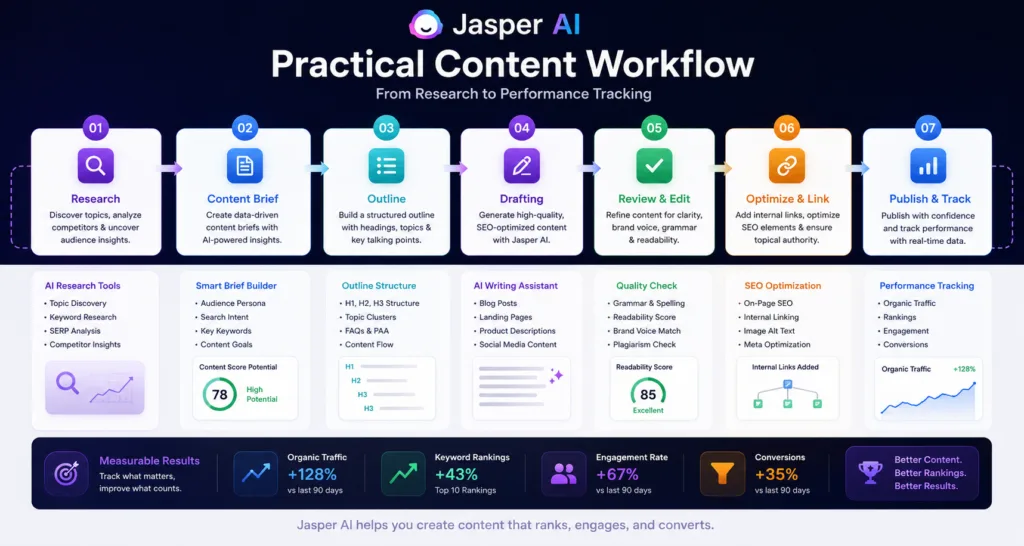
Here is a realistic content production workflow using Jasper AI from research to performance tracking. This is not a theoretical pipeline. It is how a small marketing team might actually operate.
Each step has a clear owner and validation point. Jasper AI accelerates the drafting and structuring stages but does not replace fact-checking or editorial judgment. The goal is speed without sacrificing trust.
Jasper AI vs ChatGPT
ChatGPT is a general-purpose conversational AI. Jasper AI is a marketing-focused content platform. The difference shows up in day-to-day use. ChatGPT is flexible, good for brainstorming, coding help, research and open-ended tasks. Jasper AI is structured, better for brand-consistent content and team workflows.
| Dimension | Jasper AI | ChatGPT |
|---|---|---|
| Writing | Marketing-optimised, brand-aware | General, flexible, depends on prompt |
| General reasoning | Limited, focused on content | Strong, broad |
| Marketing workflows | Built-in | Requires manual setup |
| Brand voice | Persistent memory and controls | Manual prompt repetition |
| Flexibility | Moderate | High |
| Coding | Not suitable | Useful |
| Research | Basic | Moderate, better with browsing |
| Content workflows | Strong, purpose-built | Manual |
| Team use | Good | Individual or manual sharing |
| Ease of use | Easy for marketers | Easy for general users |
| Best use case | Brand-aligned content at scale | General AI assistant, exploration |
These tools complement each other. You might use ChatGPT for ideation and Jasper AI for production. For a detailed beginner guide on ChatGPT, see Complete ChatGPT Guide for Beginners | How to Use ChatGPT.
Jasper AI vs Google Gemini
Google Gemini is a multimodal AI assistant with strong ties to Google’s ecosystem. It handles text, images, audio and video, and it can browse the web. Jasper AI is more narrowly focused on marketing content. Gemini is useful for research, general knowledge and creative exploration. Jasper AI is better for structured content production with brand controls.
If your team lives in Google Workspace, Gemini may feel natural. If your team produces marketing campaigns with consistent brand voice, Jasper AI is more purpose-built. Both can coexist: Gemini for research, Jasper for output. For a deeper look at Gemini, see Google Gemini Explained: Features, Models, Pricing & How to Use It.
Jasper AI vs Microsoft Copilot
Microsoft Copilot is integrated into Windows, Office and Edge. It is a productivity assistant that helps with documents, spreadsheets, meetings and coding. Jasper AI is not a general productivity tool. It is a content marketing platform. If you want help summarising an email thread or drafting a PowerPoint, Copilot is better. If you want to produce a 20-piece campaign with brand voice, Jasper AI is more relevant.
For most marketing teams, the choice is not either/or. You may use Copilot for internal productivity and Jasper AI for customer-facing content. See Microsoft Copilot: The Complete Guide (2026) for more details.
Jasper AI vs Other AI Tools
The AI tool ecosystem in 2026 is crowded. Jasper AI competes with ChatGPT, Copy.ai, Writesonic, Notion AI and specialised writing tools. It also overlaps with broader platforms like Canva AI, Synthesia and Midjourney when you need visual or video assets. Jasper AI’s niche is brand-aware marketing copy at scale. If you need that, it makes sense. If you need general AI assistance, The Ultimate Guide to AI Tools (2026) can help you navigate the options.
Jasper AI Pricing
Pricing for Jasper AI changes frequently, and plans vary by region, team size and feature set. I will not invent exact numbers here. The reliable approach is to visit Jasper’s official pricing page before making a decision. That said, you should evaluate plans based on a few practical factors:
- Number of users who need access
- Usage limits and content generation volume
- Brand voice and memory features
- Collaboration and approval workflows
- Marketing automation and repurposing tools
- Integrations with your CMS or other tools
- Support and onboarding
Practical tip:Do not pay for seats you will not use. Start with a small team trial, test the brand voice and workflow features, then scale only if the time saved justifies the cost. Many teams over-buy AI tools in the first month.
Is Jasper AI Worth It?
The honest answer is: it depends on your content volume and brand requirements. Jasper AI is most valuable for marketing teams, content teams, agencies, businesses and brand-heavy organisations that produce a lot of customer-facing content. If you need consistent voice across dozens of assets, the brand memory and workflow features pay for themselves in reduced editing time.
Jasper AI is less suitable for casual users, people who just want a simple chatbot, users who occasionally generate text, or developers looking primarily for coding help. If your main use is “write a quick email” or “explain a concept”, a general assistant like ChatGPT or Gemini is enough.
From a workflow perspective, Jasper AI makes more sense when the problem is not simply “write this paragraph”, but “help my team produce consistent marketing content at scale”. That distinction matters more than any feature comparison.
Jasper AI Pros and Cons
| Pros | Cons |
|---|---|
| Strong brand voice memory | Pricing can be high for small teams |
| Marketing-focused templates and workflows | Less flexible than general chatbots |
| Good team collaboration features | Not suitable for coding or deep technical work |
| Content repurposing from a single asset | AI output still needs human editing |
| SEO briefs and outline generation | Risk of generic content without strong briefs |
| Persistent context across documents | No real-time web research without manual input |
| Reduces blank-page friction | May encourage overproduction of mediocre content |
| Good for agencies and content teams | Not a replacement for specialised SEO tools |
Developer insight:Jasper AI is a managed platform, which means you trade flexibility for convenience. If you have engineering resources, you could build a similar workflow with an LLM API and a vector store. Most marketing teams do not want to build that. That is the market Jasper serves.
Jasper AI for Different Users
| User group | Usefulness | Why |
|---|---|---|
| Bloggers | Moderate | Good for drafting and repurposing, but many free tools can do similar tasks |
| SEO specialists | High | Briefs, outlines, semantic coverage and meta copy save time |
| Copywriters | High | Fast iteration on ad copy, landing pages and product descriptions |
| Marketing agencies | Very high | Brand voice, collaboration and multi-client workflows |
| Startups | Moderate | Useful once content volume grows; may be overkill at early stage |
| E-commerce businesses | High | Product descriptions, category copy, emails and ad variations |
| Students | Low to moderate | Can help with brainstorming and editing, but not essential |
| Developers | Low | Not a coding assistant; better options exist for technical tasks |
| Enterprise teams | Very high | Brand controls, permissions, approvals and scale |
Jasper AI and E-E-A-T
Google’s E-E-A-T framework rewards content with Experience, Expertise, Authoritativeness and Trustworthiness. Raw AI-generated content often fails on all four fronts. It lacks first-hand experience, author identity, original insight and verified facts. Jasper AI can help you draft faster, but it cannot create E-E-A-T for you.
To use Jasper AI without damaging your SEO, follow these practices:
- Add original examples from your own work or data.
- Cite sources where appropriate.
- Fact-check every major claim.
- Attribute the article to a real author with relevant expertise.
- Explain why the reader should trust the advice.
- Avoid publishing purely AI-generated content without human editing.
- Cover search intent fully, not just keyword density.
If you treat Jasper AI as a drafting assistant rather than an author, you can maintain E-E-A-T while still moving quickly. The human layer is non-negotiable.
Jasper AI and Human Writers
AI does not replace writers. It changes the workflow. Writers who learn to use Jasper AI for research organisation, drafting, rewriting, brainstorming, repurposing and editing will produce more output without losing their voice. The human judgement remains in story selection, argument structure, tone, nuance, fact selection and ethical considerations.
A few areas where Jasper AI helps writers most:
- Overcoming blank-page friction
- Generating multiple angles quickly
- Repurposing long-form into short-form
- Producing first drafts for editing
- Structuring content briefs and outlines
- Rewriting awkward sentences
- Maintaining consistent terminology
The writer still decides what matters, what to include, and what to leave out. That is the core of the craft.
Jasper AI and Content Quality
AI-generated content has known failure modes: hallucinations, generic writing, repetition, brand inconsistency, factual errors, over-optimisation and lack of original experience. Jasper AI reduces some of these risks with brand memory and structured prompts, but it does not eliminate them.
Practical solutions:
- Always fact-check outputs, especially statistics and dates.
- Review for repetition and cliché phrases.
- Add original examples from your own work.
- Use brand voice controls to avoid generic tone.
- Run content through a human editor before publishing.
- Do not chase keyword density at the expense of readability.
- Track content performance and adjust workflows accordingly.
Watch out:The biggest risk with AI writing is not bad grammar. It is confidently wrong information wrapped in polished prose. Always verify before you publish.
Jasper AI for Developers and Technical Teams
Developers are not the primary audience for Jasper AI, but technical teams can still use it around documentation, product copy, release notes, technical marketing, landing pages, developer marketing and internal documentation. For example, a developer advocate could use Jasper AI to turn a release note into a blog post or a set of social updates.
Jasper AI is not a coding assistant. If you need code generation or technical deep dives, you are better served by GitHub Copilot AI: The Complete 2026 Review by a Developer Who Uses It Daily or Cursor AI: The Complete Guide (2026).
For developer-facing content, Jasper AI can help produce documentation summaries, product announcements, and API release notes. But the technical accuracy must come from the developer, not the model.
Jasper AI and AI Automation
AI writing tools fit into a larger automation stack. You can connect Jasper AI with project management, CMS, CRM and analytics tools to create a content pipeline. For example, a campaign brief in Notion could trigger a Jasper AI draft, which then goes through human review and gets published to your CMS.
This is not something Jasper AI does natively for every integration, but the workflow concept is sound. To understand how AI tools work under the hood, see How AI Tools Work: What Actually Happens Behind the Screen. For the next step after chatbots, AI Browser Assistants: The Next Step After Chatbots is a useful read.
Jasper AI vs Dedicated Creative AI Tools
Jasper AI writes text. It does not create images, videos, or audio. For visual content, you need tools like Midjourney, Flux, Runway, Seedance, Canva AI or Synthesia. These tools complement Jasper AI rather than compete with it.
For example, you could use Jasper AI to write a video script, then use Synthesia to create an AI avatar video, or Runway to generate b-roll. A complete AI content stack includes writing, image, video and automation layers. Jasper AI owns the writing and brand voice layer.
If you need image generation, explore Midjourney AI: The Complete 2026 Guide for Creating AI Images Like a Professional or Flux AI: The Complete 2026 Guide to AI Image Generation, Models, Prompting & Professional Workflows. For video, see Runway AI: The Complete 2026 Guide to AI Video Generation or Seedance 2.0 Review (2026): Features, Pricing, Pros & Is It Worth Using?. For design and video avatars, Canva AI: The Complete 2026 and Synthesia AI: The Complete 2026 are worth checking.
Jasper AI and Knowledge Management
Content teams often struggle to keep brand knowledge, product facts and content assets organised. Jasper AI stores some context, but for a full knowledge management system, tools like Notion AI are more appropriate. You can use Notion as your source of truth and Jasper AI as the writing engine.
For a deeper look at how AI can improve research and productivity inside a knowledge base, see Notion AI: The Complete 2026 Guide to AI Writing, Research & Productivity.
Jasper AI and Document Intelligence
Document intelligence platforms help you extract insights from files, contracts, reports and internal documents. Jasper AI does not specialise in that area, but the outputs from a document intelligence tool could feed into Jasper AI prompts for content creation. For example, you might extract key themes from customer interviews and then use Jasper AI to turn those into marketing copy.
If your team works with large document sets, Continua AI Review 2026: A Document Intelligence Platform That Actually Understands Your Files is a relevant tool to explore alongside Jasper AI.
Jasper AI and E-commerce
E-commerce teams can use Jasper AI for product descriptions, category pages, ad copy, email campaigns, product storytelling and Amazon workflows. The brand voice feature is especially useful when you have hundreds of products and need consistency across all listings.
For Amazon-specific AI tools, Best Amazon AI Tools You Should Try in 2026 is a practical resource. If your e-commerce business is exploring AWS-based generative AI, Amazon Bedrock: The Complete 2026 Guide to AWS Generative AI provides the technical background.
Jasper AI for Students
Students can use Jasper AI responsibly for brainstorming, editing, study notes, research organisation, presentation copy and writing improvement. It can help you clarify ideas, restructure essays and generate study questions. However, it should not be used to write academic work for you. That crosses an ethical line and undermines the learning process.
For more student-focused AI tools, see Best AI Tools for Students: 18 Apps I Actually Use to Study Smarter.
Jasper AI Alternatives
Several tools compete with Jasper AI depending on your needs:
- ChatGPT: General-purpose AI assistant. Great for ideation, research and flexible writing. Less structured for brand workflows.
- Google Gemini: Multimodal AI with strong research and integration with Google Workspace.
- Microsoft Copilot: Productivity assistant embedded in Office and Windows.
- Claude: Strong writing quality and long context. Often preferred for nuanced, careful output.
- Copy.ai: Similar to Jasper AI but lighter and often cheaper. Good for shorter marketing copy.
- Writesonic: AI writing with SEO and marketing features. Competitive pricing.
- Notion AI: Built into Notion. Good for teams already using Notion as their knowledge base.
The right choice depends on your content volume, brand requirements and existing tool stack. For a broad view of the landscape, refer to The Ultimate Guide to AI Tools (2026).
Jasper AI Mistakes to Avoid
- Publishing raw AI output without human review.
- Ignoring fact checking, especially for statistics and dates.
- Overusing keywords to chase SEO instead of serving search intent.
- Skipping brand context and then complaining the output is generic.
- Using weak prompts with no structure, audience or examples.
- Treating AI output as final without adding original insight.
- Relying on AI for E-E-A-T instead of human expertise.
- Ignoring search intent and creating content nobody wants.
- Measuring output volume instead of business results.
- Publishing content with no clear author or source attribution.
Jasper AI Best Practices
- Always start with a clear brief, not a vague topic.
- Configure brand voice before generating content.
- Use templates as starting points, not rigid scripts.
- Edit every AI draft for tone, accuracy and originality.
- Add first-hand examples and data from your own experience.
- Fact-check every claim, especially numbers and quotes.
- Use Jasper AI for repurposing to save distribution time.
- Track content performance and iterate on prompts.
- Involve subject matter experts in the review process.
- Do not over-automate the human layer out of the workflow.
Jasper AI Content Workflow Example
Imagine a fictional technology company, CloudPeak, launching a new analytics dashboard. The marketing team uses Jasper AI like this:
- Brief: They create a campaign brief with audience, value proposition and key messages.
- Brand context: The team has already configured Jasper AI with CloudPeak’s voice: clear, technical but approachable, no hype.
- Draft: Jasper AI generates a blog post, three email variants, five LinkedIn posts and a landing page section from the same brief.
- Fact checking: A product manager reviews the draft for technical accuracy.
- SEO optimisation: The content lead adjusts headings, meta description and internal links. They use AI in SEO: How to Build a Modern Content Strategy principles to guide the optimisation.
- Human editing: A writer adds a real customer example and tightens the opening.
- Publishing: The team pushes the content to their CMS and schedules social posts.
- Performance tracking: They monitor organic traffic, email click-throughs and social engagement for two weeks.
This workflow is realistic and repeatable. The AI handles volume, the humans handle quality and trust.
Jasper AI Performance Evaluation
How do you know if Jasper AI is actually helping? Track these metrics before and after adoption:
| Metric | What to measure |
|---|---|
| Time saved | Hours per content piece before and after Jasper AI |
| Content output | Number of published pieces per week |
| Editing time | Average editing minutes per draft |
| Organic traffic | Search traffic to AI-assisted content over 90 days |
| Conversion rate | Percentage of readers taking a desired action |
| CTR | Click-through rate on titles and meta descriptions |
| Engagement | Comments, shares, time on page |
| Content quality | Editorial review score or reader feedback |
| Brand consistency | Adherence to voice and style guidelines |
| Cost per published article | Total cost divided by number of articles |
If Jasper AI reduces editing time and increases consistent output without hurting quality, it is earning its cost. If you are only producing more generic content that nobody reads, the tool is not solving the right problem.
Jasper AI and AI Automation
AI writing is one part of a broader automation trend. Teams can connect Jasper AI with knowledge bases, project management tools and content distribution systems to create a semi-automated content engine. The human still sets the strategy and reviews the output, but the repetitive drafting work shrinks.
For developers interested in building AI-assisted tools, Replit AI: The Complete 2026 Review provides a practical look at AI-assisted development. For research-heavy workflows, Perplexity AI Review: The Search Engine That Actually Cites Its Sources is a useful complement to Jasper AI’s writing focus.
Where Jasper AI Fits in the Modern AI Content Stack
Jasper AI is not a silver bullet. It is a writing and brand consistency layer in a larger stack. A modern AI content stack might include:
- Research: Perplexity, ChatGPT browsing, Google Gemini
- Writing and brand: Jasper AI, Copy.ai, Writesonic
- SEO: Ahrefs, Semrush, AI in SEO strategies
- Images: Midjourney, Flux AI, Canva AI
- Video: Runway AI, Seedance 2.0, Synthesia AI
- Knowledge: Notion AI, Continua AI
- Automation: AI browser assistants, custom API workflows
- Human editorial: Writers, editors, subject matter experts
Jasper AI earns its place when the bottleneck isn’t “can we generate text” but “can we generate text that sounds like us, at scale, without each piece taking three hours”. If that’s your bottleneck, it’s worth evaluating. If not, a general assistant may be all you need.
So where does Jasper AI actually fit in a modern content workflow? Somewhere between raw AI output and human publishing: a tool for teams that need consistency, speed and brand alignment across a lot of content, rather than for someone who just wants a clever paragraph. It fits some workflows and not others, and either way a human still needs to check the work before it goes out.