

Every few months a new AI model name starts making the rounds in developer chats, SEO briefs and tool roundups. Claude Fable 5.1 is one of those names. It sounds plausible enough, specific enough, almost official. But there’s no publicly documented Anthropic model by that name as of this writing: no release notes, no API card, no research paper, no pricing page. That doesn’t mean the phrase is meaningless. Usually it means someone merged two different ideas, a Claude model and something called Fable, or there’s a typo, or an internal codename leaked into public conversation.
This piece won’t invent benchmarks for a model that may not exist. What it will do is dig into where the name probably comes from, explain how to evaluate AI tools without leaning on marketing copy, and walk through coding, writing and automation workflows that apply to any modern Claude-class assistant. If you landed here after seeing “Claude Fable 5.1” in a AI tools guide, this should help separate what’s real from what isn’t.
What Is Claude Fable 5.1?
There’s no Claude Fable 5.1 model page on anthropic.com, no research announcement, no API documentation. When a name like this can’t be traced to a primary source, the safest move is to treat it as a possible misnomer, an internal reference, or confusion between two different tools. The phrase could be a hybrid of Anthropic’s Claude family and something called Fable, maybe a storytelling tool, a game engine concept, an accessibility feature, or a product from another vendor entirely.
If someone drops “Claude Fable 5.1” into conversation, ask where it came from. Not to be difficult, just because AI model names change fast and a lot of SEO content gets generated from vague prompts. Check the official Anthropic documentation and release notes yourself. If all you find are third-party blogs and affiliate roundups, the name almost certainly isn’t official. The same check applies to anything you read about how AI tools work or any other emerging model claim.
From a developer’s perspective, the useful question isn’t “Is Claude Fable 5.1 real?” but “What capability is this name supposed to describe?” If it’s long-form writing, the underlying model might behave like Claude Opus or Sonnet. If it’s agentic coding, it might resemble Claude Code or API tool use. If it’s storytelling, maybe a fine-tuned Claude variant got used somewhere without official branding.
Is Claude Fable 5.1 an Official Claude Model?
No, not according to any current Anthropic documentation. The official Claude line is Opus, Sonnet and Haiku, with version numbers like 3.5 or 4. There’s no Claude Fable 5.1 in that lineage, and the name itself is a red flag: Anthropic doesn’t use product-like suffixes such as “Fable” in its model identifiers.
This matters because bogus model names often show up in keyword research tools. Marketers spot search volume, assume the model exists, and write content around it. The result is a feedback loop where unverified information becomes “real” just because enough pages repeat it. Before building anything in production, check the model card, the API changelog and the official announcement. The same caution applies to articles about AI browser assistants that reference internal codenames.
Reality check: If a model name cannot be found on the official provider’s documentation, treat it as unverified. Do not use it in a production system, a research paper or a client deliverable without confirming the source.
Where the Claude Fable 5.1 Name Comes From
The likely origin is two streams colliding. One is Anthropic’s Claude family, known for strong writing, long-context reasoning and coding. The other is “Fable,” a word various projects use for AI storytelling, game development and creative writing. There’s also a simpler explanation: a transcription error. “Claude 5.1” gets spoken or typed somewhere, and “Fable” slips in from voice-to-text software or a non-technical editor.
Another possibility is a comparison article that merged Claude with a separate tool, such as Continua AI or a creative writing assistant, then tacked on a version number. It reads as authoritative until you try to verify it. Which is exactly why any AI content strategy needs a fact-checking step, especially for fast-moving technology.
Claude Fable 5.1 and the Claude AI Ecosystem
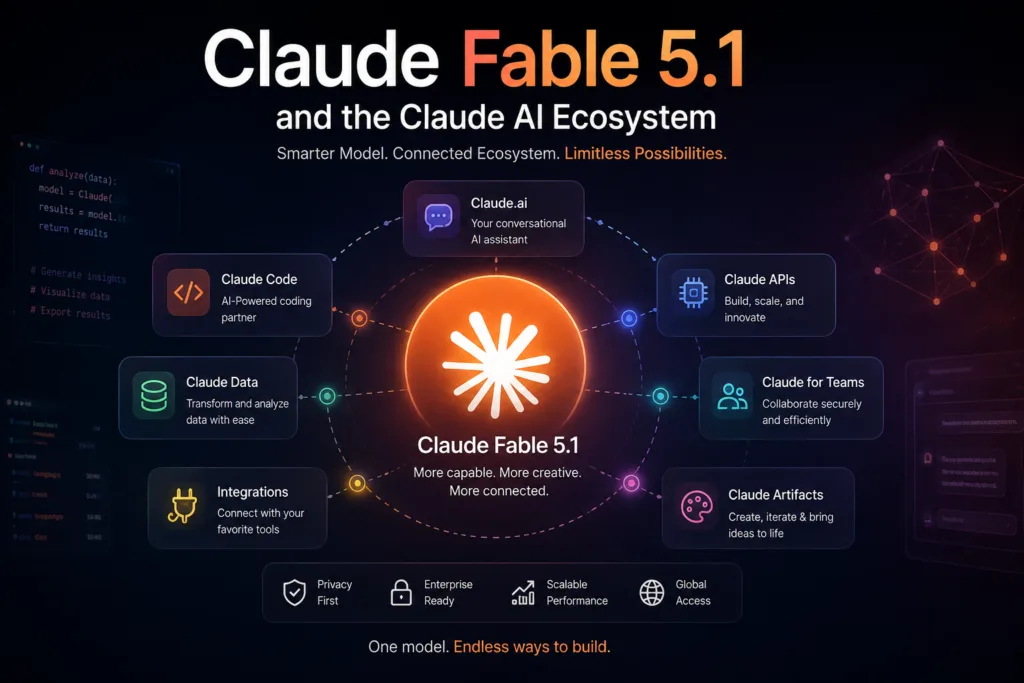
Strip away the unverified name and the real question is where a hypothetical advanced Claude model would fit. Anthropic’s ecosystem covers API access, the Claude web interface, Claude Code for the terminal, browser extensions, and integrations with platforms such as Amazon Bedrock. Plenty of developers use Claude through third-party environments like Replit AI or alongside GitHub Copilot.
When people talk about Claude and advanced writing or agentic behaviour, they usually mean a frontier model with a large context window, strong tool calling and good instruction following. Naming confusion isn’t unique to Claude, either. Models regularly ship with code names, research preview tags and community nicknames that either solidify into something official or just disappear.
For teams evaluating AI assistants, the model name matters less than the capability profile. You can test reasoning, code generation, retrieval and instruction following without ever knowing the internal label. The first thing I’d check is whether the API accepts tool definitions and how reliably it handles multi-step tasks. That tells you more than chasing a version number.
Claude Fable 5.1 Features and Capabilities
Since the exact model is unverified, what follows describes features commonly associated with current-generation Claude models and how they play out in practical tasks. If Claude Fable 5.1 turns out to be real, this evaluation framework should still hold.
Writing and Long-Form Content
Claude models are generally good at producing coherent, structured long-form writing with a natural tone, which makes them useful for drafting technical documentation, release notes, API guides and internal knowledge base articles. The real test isn’t a demo, it’s asking for a 3,000-word technical guide with specific constraints and seeing what comes back. Strong models stay consistent, avoid repetition and follow formatting instructions; weaker ones drift into generic filler. A good way to check is to hand the model a messy outline and ask for a clean technical article with cross-references and code samples. The output quality tells you more than any benchmark.
Coding and Software Development
Modern Claude models handle code generation, bug analysis and refactoring reasonably well, especially with clear context and error messages. A benchmark can look impressive while the actual workflow still feels clunky, though. Integration is what matters: terminal tools such as Claude Code let the model see a repository, run tests and make edits, and that’s where the usefulness jumps. Compared with Cursor AI, the difference often isn’t raw intelligence so much as how tightly the model is coupled to the editor and file system.
Reasoning and Problem Solving
Recent Claude versions have gotten better at multi-step reasoning, especially for tasks involving planning, comparison and conditional logic. Developers use them for architecture decisions, debugging strategies and test case generation. Asking the model to explain its reasoning before giving a solution makes errors easier to catch, but it can still produce confident nonsense. Verify the output, particularly around security, compliance and performance tuning.
Research and Information Analysis
Claude’s retrieval and summarisation hold up well when you give it the source material directly: it can compare documents, pull out key points and synthesise findings. The weak spot is knowledge cutoffs and the risk of hallucination. For current information, use something with live search such as Perplexity AI, or a retrieval-augmented workflow instead. For internal documentation, though, Claude-style models can save real time.
Working With Large Amounts of Context
Many Claude models support large context windows, useful for analysing long codebases, research papers or legal documents. The practical limit depends on the model version and the platform, so check the official API documentation before relying on a stated number. Don’t assume a marketing mention of “Claude Fable 5.1” implies any specific context window.
Claude Fable 5.1 for Developers
If you’re a developer trying to get value from a Claude-class model, focus on workflow design rather than the exact name. Here’s where current models genuinely help.

Code Generation
Provide a clear function signature, expected input, output and edge cases. The model can scaffold code quickly. But do not paste generated code into production blindly. Review it, run static analysis and write tests. This is the same discipline required when using GitHub Copilot.
Debugging
Give the model the full error message, relevant code and a description of what you expected. Ask for root cause analysis before the fix. Claude-style models are often good at spotting off-by-one errors, incorrect imports or API misuse. But they can also invent a plausible cause that is completely wrong. Verify before patching.
Refactoring
Refactoring requires understanding intent. Ask the model to explain the current behaviour first, then propose a safer refactor with tests. Without tests, refactoring suggestions are risky. A good workflow is to run the test suite before and after applying the AI suggestion.
Documentation
One of the most underrated AI uses is generating first drafts of README files, API docs and changelogs. Feed the model the code and ask for concise, accurate documentation with examples. Then edit manually. AI-generated docs still need human review because the model can describe code that does not exist or misunderstand a function’s purpose.
Building AI-Assisted Workflows
Beyond ad hoc prompts, many teams now build AI directly into their tooling. Platforms like n8n AI and Zapier AI let automations call an LLM at specific steps. A developer might build a workflow that receives a bug report, asks Claude to classify it, drafts a response, then waits for human approval. What actually matters is how it handles edge cases: good workflow design means validation, retry logic and logging.
Practical Claude Fable 5.1 Prompts
These prompts work with modern Claude models and show the kind of instruction style that produces better output. They aren’t specific to Claude Fable 5.1, since that model is unverified, but the same prompt engineering principles apply.
Prompt for debugging
You are reviewing a production Python application. First identify the root cause of the bug. Then explain why it occurs. Then provide the smallest safe fix. Do not rewrite unrelated parts of the code. Finally, provide three tests that would catch this bug in the future.
Prompt for technical documentation
Write a developer-facing README section for a REST API. The API accepts JSON, returns JSON and uses bearer token auth. Include endpoints, request examples, response examples and error codes. Use British English. Keep the tone concise and practical. Do not invent endpoints that are not in the code.
Prompt for content writing with SEO
Create a 1,500-word draft for a blog post about AI workflow automation. Target the keyword “AI workflow automation” naturally. Include a developer perspective, practical examples and one comparison table. Do not use generic phrases such as “cutting-edge” or “in today’s digital landscape”. Write for a technically capable reader. Use British English. Do not add an FAQ section.
Prompt for research summarisation
Given the attached document, produce a 400-word executive summary. Focus on methodology, key findings, limitations and practical implications. Do not add your own interpretation beyond the text. Highlight any claims that appear unsupported. Use bullet points for key findings.
Prompt for data analysis
Analyse the provided CSV data. Identify outliers, missing values and potential data quality issues. Suggest a simple validation pipeline in Python. Do not perform statistical tests without explaining assumptions. Provide the analysis in a structured report with tables.
Prompt for AI automation workflow
Design an n8n workflow that receives an email, classifies it as support, sales or spam, and routes it accordingly. Include a human approval step for the sales category. Describe the nodes, data flow and error handling. Explain where AI is useful and where deterministic rules are better.
Notice that the strongest prompts include context, constraints and verification. A weak prompt such as “Write some Python code for my app” gives the model too much freedom. The better version defines the function, edge cases and test expectations. This is the core of ChatGPT beginner guide advice, and it applies equally to Claude-style tools.
Claude Fable 5.1 for Content Writers
Writers exploring AI assistance often look at tools like Jasper AI, Notion AI or the native Claude interface. The appeal is speed and structure; the risk is generic output, factual errors and a flattened voice. For a hypothetical model like Claude Fable 5.1, the editorial workflow should still include research, drafting, fact-checking, SEO refinement and a human edit. AI can handle the draft and the SEO suggestions, but a person has to verify the sources and keep the voice distinct.
When writing with Claude, give it examples of your preferred style. Ask for a specific tone, sentence rhythm and level of detail. If you use AI for a first draft, treat it as a starting point, not a final article. A useful trick is to generate three alternative introductions, pick the best, then edit heavily. The result feels far more authentic than just accepting the first response.
For SEO-focused content, the AI in SEO landscape has shifted toward topic depth and user intent. A good AI writer should help you cover subtopics you’d have missed, but keyword placement still needs to feel natural. If the model can’t stop awkwardly repeating “Claude Fable 5.1,” the output isn’t ready; rewrite it or adjust the prompt.
Claude Fable 5.1 for Students and Researchers
Students often use AI for summarisation, exam preparation and writing support. The best AI tools for students are those that encourage understanding rather than shortcutting the learning process. For research, a Claude-style model can help break down dense papers, generate discussion questions and create study outlines. But students should verify every claim against the original source. AI can misquote, invert causality or omit limitations.
Researchers should be particularly careful with AI summaries. A model might smooth over conflicting findings or present a minority view as consensus. Before relying on any AI-generated summary, check the original abstract, methods and discussion sections. The same applies when using Amazon AI tools for document processing or analysis. AI accelerates review, but it does not replace critical reading.
Claude Fable 5.1 for Businesses
Business teams evaluate AI for customer support, internal knowledge management, report generation and process automation. The promise of a model like Claude Fable 5.1 is usually faster drafting, fewer repetitive tasks and better information retrieval. In reality, deployment takes careful prompt design, access control and human oversight. Tools such as Microsoft Copilot and Notion AI have already normalised embedded AI in office workflows, but the same governance rules apply to any model.
Businesses should also consider the cost of incorrect AI output. A customer support email that sounds confident but contains the wrong policy is worse than no automation at all. The responsible approach is to start with internal workflows where a human reviews output before it reaches customers. Once accuracy is proven, expand gradually.
Claude Fable 5.1 vs ChatGPT
ChatGPT and Claude are both powerful general-purpose assistants. ChatGPT benefits from a huge ecosystem, strong multimodal features and broad integration. Claude is often praised for natural writing, long-context handling and developer-friendly API design. The best choice depends on the task. For conversational search and image generation, ChatGPT is more mature. For long technical documents and coding workflows, some developers prefer Claude. If you are new to AI, a ChatGPT beginner guide can help you understand the fundamentals before comparing alternatives.
When comparing unverified names such as Claude Fable 5.1, avoid numerical claims. Instead, run your own tests on real tasks. Write a technical spec, generate a test suite and summarise a long document. See which model follows instructions more consistently and where you need to intervene. That practical comparison is more useful than any benchmark chart.
Claude Fable 5.1 vs Google Gemini
Google Gemini offers tight integration with Google Workspace, search and multimodal understanding. The Google Gemini explained ecosystem focuses on productivity and knowledge retrieval. Claude’s strengths tend to be long-form reasoning and developer tooling. If your work involves spreadsheets, email and calendar automation, Gemini may be the smoother option. If you are writing complex technical documentation or building AI workflows, Claude-style models may feel more flexible.
Again, the unverified “Fable 5.1” label does not change the fundamentals. You still need to evaluate context length, tool support and instruction following. Do not assume that a higher version number means better performance. Test the actual behaviour on your workload.
Claude Fable 5.1 vs Microsoft Copilot
Microsoft Copilot is deeply embedded in Office apps, Windows and GitHub. For enterprise users already inside the Microsoft ecosystem, Copilot is the path of least resistance. Claude models are more common in developer environments that value API control and custom prompts. If you are using Visual Studio Code, GitHub Copilot may feel native. If you prefer terminal-based coding with Claude Code, the Claude ecosystem is more natural.
The comparison is not about raw intelligence. It is about context switching, UI integration and trust. A model can be excellent in isolation but frustrating if it requires constant copy-paste or lacks access to your repo. That is why developer tools like Cursor AI have gained traction. They reduce friction.
Claude Fable 5.1 vs Perplexity
Perplexity AI is fundamentally different. It is an answer engine with live search and citations. Claude models generate text but do not search the web by default. For current events, fact-checking or source-grounded research, Perplexity is stronger. For generating long-form structured content or coding from a given context, Claude is more capable. The two tools can complement each other. Use Perplexity to verify sources, then use Claude to synthesise and draft.
Claude Fable 5.1 for Coding: How It Compares With Cursor and GitHub Copilot
Cursor AI and GitHub Copilot are both editor-centric AI coding assistants. Cursor offers deep codebase awareness and multi-file edits. Copilot integrates smoothly with VS Code and GitHub. Claude Code is a terminal-based agent that can execute commands and read repositories. The best choice depends on your workflow. If you like staying in the editor with inline suggestions, Copilot or Cursor win. If you prefer a conversational agent that can run tests and iterate, Claude Code is compelling. The unverified Claude Fable 5.1 name does not change this calculus.
When testing a coding AI, start with a real task. Give it a small repository, a failing test and an instruction to fix the bug. Then review the diff carefully. Ask the model to explain its reasoning. If the explanation is coherent and the tests pass, the workflow is usable. If the model makes wild changes or fabricates APIs, it is not ready for your stack. This is the same advice given in guides about GitHub Copilot and Cursor AI.
Claude Fable 5.1 Workflow Examples
Realistic workflows show where AI helps and where human judgement is essential.
Workflow 1: Developer bug resolution
1. A bug report arrives with an error trace.
2. The developer shares the relevant code and error with Claude.
3. Claude proposes a root cause and a patch.
4. The developer reviews the patch, runs tests and checks for regressions.
5. Claude reviews the test result and suggests additional edge cases.
The human makes the final merge decision.
Workflow 2: Content production
1. Writer gathers sources and keyword data.
2. Writer creates an outline.
3. Claude drafts sections based on the outline.
4. Writer verifies facts and adds original insight.
5. Claude suggests SEO refinements and internal link opportunities.
The human edit ensures the voice is not generic.
Workflow 3: AI automation with human approval
1. A trigger fires (email received or form submitted).
2. AI classifies the message and drafts a response.
3. A validation step checks confidence and required fields.
4. A human approves or edits the draft.
5. The action is executed and logged.
This pattern works well in Zapier AI or n8n AI.
Claude Fable 5.1 Strengths and Weaknesses
Strengths (editorial assessment of Claude-class models)
- Natural long-form writing with strong structure
- Useful for code generation, debugging and documentation
- Handles long context for document analysis
- Clear instruction following when prompts are specific
- Strong tool calling for developer workflows
Weaknesses and risks
- Can hallucinate APIs, facts and version numbers
- No default web search unless integrated with retrieval
- Generated code still requires testing and review
- Benchmark performance may not reflect real-world friction
- Naming confusion such as “Claude Fable 5.1” obscures actual capabilities
Common Mistakes When Using Claude Fable 5.1
- Blindly trusting generated code without running tests
- Accepting unsupported claims about model capabilities
- Using vague prompts that give the model no constraints
- Ignoring source quality when asking for research summaries
- Feeding sensitive information into public AI systems
- Confusing a polished demo with reliable production behaviour
- Assuming a higher version number is always better
Before you deploy: Check the official model documentation. Confirm token limits, context window, data retention and API stability. Do not build a production feature on a name you cannot verify.
How to Write Better Claude Fable 5.1 Prompts
Prompt engineering is not about magic words. It is about clarity. Include role, context, constraints, input data, expected output, examples and verification steps. Here is a weak prompt and a better one.
Weak: Write some Python code for my app.
Better: Build a Python function that validates incoming JSON data against a schema. The function receives a dictionary and a schema dictionary. Return a list of errors, or an empty list if valid. Include support for required fields, type checks and nested objects. Write three unit tests for valid and invalid inputs. Use British spelling in comments. Explain the algorithm in two sentences before the code.
The better prompt removes ambiguity and reduces the chance of a hallucinated response. It also makes verification easier because the expected behaviour is explicit. This is the same discipline recommended for Midjourney AI image prompts, where detail dramatically improves output.
Claude Fable 5.1 and AI Automation
AI automation is moving beyond simple chatbots toward multi-step workflows that involve classification, drafting, validation and action. Tools like n8n AI, Zapier AI and Continua AI make it easier to connect AI to apps and services. A Claude-class model can serve as the reasoning layer in these workflows, but it should not be the only layer. Deterministic validation, human approval and logging are essential.
For example, an automation could receive a customer email, classify the sentiment, draft a reply and then route the draft to a support agent. If the model is not confident or the request involves a refund, the workflow stops for human review. This balances speed with safety. The same pattern appears in Amazon Bedrock implementations, where enterprises build AI pipelines with guardrails.
Claude Fable 5.1 in the Bigger AI Tools Landscape
The AI ecosystem includes general assistants, coding tools, creative tools and automation platforms. ElevenLabs AI focuses on voice, Synthesia AI on video, Flux AI and Seedance 2.0 on image and video generation, Runway AI on creative editing, and Shoomble AI on niche creative workflows. Claude-style models occupy the text and reasoning layer, often connecting with these tools through APIs or orchestration.
What this means in practice is that no single model does everything. A sensible stack might use Claude for drafting and reasoning, Perplexity for live research, GitHub Copilot for editor suggestions and n8n for automation. The unverified Claude Fable 5.1 name does not occupy any confirmed slot in this stack. Until it appears in official documentation, it remains a search term rather than a product.
AI Tool Comparison
Claude Fable 5.1 vs leading AI tools
| AI Tool | Best For | Coding | Writing | Research | Beginner Friendly | Main Strength |
|---|---|---|---|---|---|---|
| Claude Fable 5.1 Unverified | Not independently verified | Not independently verified | Not independently verified | Not independently verified | Not independently verified | Likely a naming confusion or unverified term |
| Claude Official | Long-form writing, coding, document analysis | Good with provided sources | Natural prose and long context | |||
| ChatGPT | General assistant, multimodal, search | Good with browsing | Broad ecosystem and usability | |||
| Google Gemini | Workspace integration, multimodal | Strong with Google Search | Tight Google product integration | |||
| Microsoft Copilot | Office and GitHub workflows | Embedded in Microsoft tools | ||||
| Perplexity | Cited research and search | Source-grounded answers | ||||
| Cursor AI | Editor-native coding | Deep codebase awareness | ||||
| GitHub Copilot | Inline code suggestions | Seamless VS Code integration |
Note: “Claude Fable 5.1” could not be independently verified as an official Claude model name. The comparison therefore treats it as an unverified or potentially confused term rather than presenting it as a confirmed product.
This table is editorial. No benchmark scores are used. “Not independently verified” is deliberately repeated for Claude Fable 5.1 because no official specification exists.
Claude Fable 5.1 Use Cases
Practical ways to structure prompts for different tasks
| Use Case | Difficulty | Example Task | Recommended Prompt Style | Potential Benefit | What to Verify |
|---|---|---|---|---|---|
|
Debugging
|
Intermediate | Fix a failing API test | Provide error, expected behaviour, constraints | Faster root cause analysis | Check the proposed fix with tests |
|
Documentation
|
Beginner | Generate README for a small repo | Include code, audience, style guide | Reduces writing time | Confirm accuracy of API examples |
|
Research Summary
|
Intermediate | Summarise a 40-page report | Ask for structure, limitations, key findings | Quick comprehension | Read the original conclusions |
|
SEO Draft
|
Intermediate | Write blog post from outline | Include keyword, tone, headings, internal links | Faster first draft | Fact-check and edit for voice |
|
Automation
|
Advanced | Classify emails and draft replies | Define categories, output format, fallback | Reduces repetitive work | Human approval step and error logging |
Give the AI enough context to understand the task, then define the expected output, constraints and anything that needs verification.
Editorial Assessment Chart
Editorial usefulness of Claude-class models by workflow (qualitative, not benchmarked)
These ratings are editorial, not official benchmark results. They reflect a general assessment of Claude-class model behaviour, not a specific Claude Fable 5.1 release.
Where Claude Fable 5.1 Fits Into the Next Generation of AI
AI model naming is getting more confusing, not less. Code names, research previews, community nicknames and marketing terms all collide, and Claude Fable 5.1 is a good example: it sounds like a product but can’t be verified. The next generation of AI will likely bring more agentic behaviour, deeper tool integration and larger context windows, but also more mislabelled model names, hallucinated version numbers and speculative SEO content.
For developers, researchers and writers, the lesson is simple: verify before you build, test before you trust, and use official documentation as the source of truth for model capabilities. When a name can’t be confirmed, say so plainly. That’s the only way to keep the AI ecosystem honest. What matters isn’t the demo, it’s what you find when you dig into the details, and the details around Claude Fable 5.1 are still unresolved.