

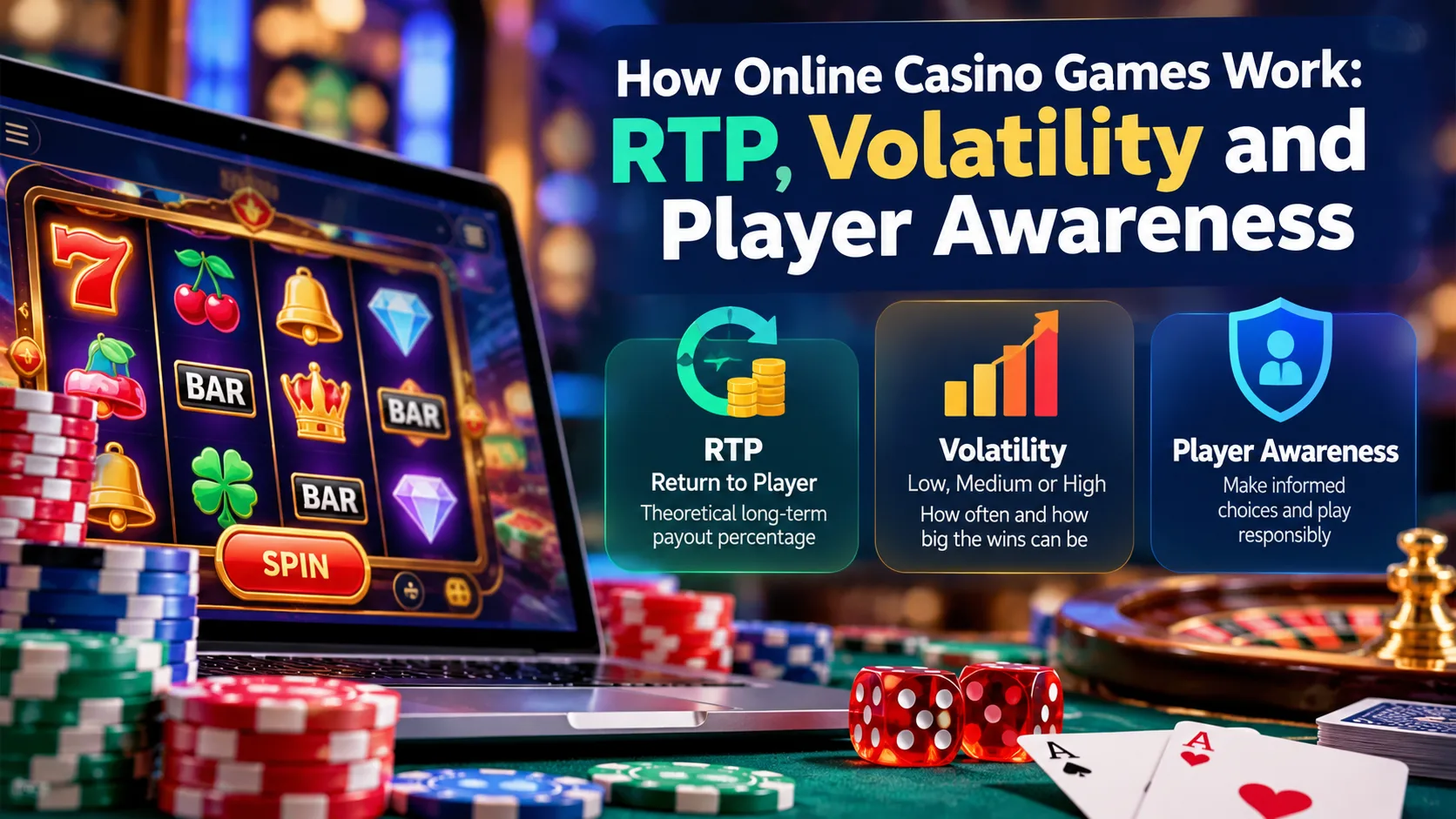
Every spin, deal and reel drop is the result of software, mathematics and regulation working together. Understanding that machinery does not make anyone luckier, but it does make the experience far less confusing.
Online casino games are among the most heavily engineered pieces of entertainment software in the world, and most people who play them never see the engineering at all. What they see is a lobby, a spinning reel, a dealer’s smile and a balance that moves up and down. What sits behind that is a specific set of mathematical rules, testing procedures and regulatory obligations that decide how often a game pays, how much it pays and how quickly a player’s money can move in either direction.
That gap between what players see and what is actually happening is where most confusion lives. It is also where a lot of poor decisions begin. If you understand what a return to player figure really means, why volatility changes the feel of a game without changing its long-run maths, and how bonus terms quietly reshape the value of an offer, you are in a much better position to decide whether you want to play at all, and on what terms.
Why the maths matters more than strategy
Search for casino advice and you will find an enormous amount of it. Betting systems, patterns, hot and cold numbers, timing theories, the idea that a machine is “due” a payout. Almost all of it rests on the same misunderstanding: that past results change future probability in a game built on independent random events.
They do not. In a game where each round is generated independently, the outcome of the last hundred rounds has no influence on the next one. A slot reel does not remember that it has not paid out recently. A roulette wheel does not develop a debt to the player. This is not a philosophical position, it is a design property of the software, and it is one of the reasons regulators and testing laboratories spend so much time verifying that randomness actually holds up under scrutiny.
What strategy can change is how long your money lasts and how volatile your session feels. Choosing a game with a lower house edge, setting a session budget, or picking a lower-volatility game all affect the shape of your experience. None of them change the underlying return of the game, and none of them turn a negative-expectation activity into a positive one. That distinction between influencing the experience and influencing the outcome is the single most useful thing to internalise.
This is why the rest of this article deals with mechanics rather than tips. Tips are usually someone else’s preferences dressed up as rules. Mechanics are simply how the thing works.
What happens when you press spin
The moment you tap a button or click a mouse, a short sequence of events takes place in a fraction of a second. Understanding that sequence makes a lot of marketing language easier to interpret.
The role of the random number generator
Most digital casino games rely on a Random Number Generator or RNG. An RNG is a piece of software that produces a continuous stream of numbers that cannot be predicted from previous outputs. When you start a round, the game takes the next value from that stream and maps it onto the game’s possible outcomes according to the rules and the paytable.
The mapping step is important. An RNG does not “decide” that you win or lose. It produces a number, and the game’s mathematics translates that number into a result. Change the paytable and you change the game’s behaviour completely, even though the RNG itself is unchanged. This is why two slots can look almost identical and behave very differently.
Independent testing laboratories, including organisations such as eCOGRA, iTech Labs and GLI, assess RNG software against recognised technical standards. Regulated operators in mature markets are typically required to use games and RNGs that have been tested and certified, and to make game rules and theoretical return figures available to players. The exact requirements differ by jurisdiction, but the principle is consistent: the maths should be documented and testable, not hidden.
Where the game rules fit in
Game rules determine what counts as a winning combination, how much each combination pays, and whether there are features such as free spins, multipliers or bonus rounds. Everything a game can do is defined in advance. The randomness only determines which of those predefined outcomes you receive on any given round.
This is why reading a paytable is genuinely useful rather than a box-ticking exercise. The paytable tells you what the game is willing to pay for each outcome. It does not tell you how often those outcomes occur, but it does tell you whether a game’s biggest advertised prize is realistically reachable or vanishingly rare.
Return to Player: a long-run average, not a promise
RTP stands for Return to Player. It is normally expressed as a percentage and describes the proportion of all money wagered on a game that is, in theory, returned to players over a very large number of rounds. A game with a 96 per cent RTP is designed so that, across millions of hypothetical spins, roughly 96 per cent of total stakes would be returned and roughly 4 per cent would be retained.
Two clarifications matter here, and both are frequently ignored in casual conversation.
First, RTP is a theoretical long-run figure. It is not a prediction of what will happen in your session, this evening or this month. In a short session, results are dominated by variance rather than by the theoretical return. A player can easily finish a session far above or far below the stated RTP, and that is entirely consistent with the maths.
Second, RTP describes the game, not the player. It says nothing about how you will bet, how long you will play, or whether you will stop. Two people playing the same game with the same RTP can have completely different experiences because their stake sizes, session lengths and decisions differ.
Worth remembering: a high RTP does not make a game safe, affordable or suitable. It is one number among several, and it describes long-run behaviour rather than any individual outcome. The theoretical return also assumes optimal play where a game involves skill or strategy, which is not true of pure chance games.
House edge and the arithmetic behind every game
The house edge is the mirror image of RTP. If a game returns 96 per cent of stakes over the long run, the remaining 4 per cent is the house edge. It represents the game’s built-in commercial margin, and it is the reason a casino business can operate at all.
House edge and RTP are not the same as your expected result in a session. They describe a mathematical relationship between stakes and returns over an enormous sample. In a single evening, the house edge is essentially invisible next to the noise of variance. Over thousands of rounds, it becomes the dominant force.
Theoretical RTP vs House Edge
See how the theoretical return to player (RTP) relates to the house edge over a very large number of wagers.
| Theoretical RTP | House Edge | What It Means in the Long Run |
|---|---|---|
| 98% | 2% | Two units retained per hundred units staked across a very large sample. |
| 96% | 4% | Four units retained per hundred staked. Common in many regulated digital games. |
| 92% | 8% | Eight units retained per hundred staked, representing a larger long-run house margin. |
These figures are illustrative examples used to explain the relationship, not verified specifications of any named game or platform. Real RTP values vary widely between games, between categories and sometimes between versions of the same game. Where a regulated operator publishes RTP, that published figure is the one that matters for that specific game.
It is also worth noting that house edge does not apply uniformly. Some games and some bets within the same game carry very different margins. In table games, the specific bet you place often matters more than which game you sit at. In slots, the margin is baked into the game’s mathematics and is not something a player can alter through bet selection.
Volatility: why two games with similar RTP feel so different
If RTP describes the destination, volatility describes the journey. Volatility, sometimes called variance, describes how widely results are spread around that theoretical average.
A low-volatility game pays smaller amounts more frequently. Your balance tends to drift rather than swing, which can make a session feel steadier and last longer at a given stake. A high-volatility game pays larger amounts far less often. Long stretches without a meaningful return are normal, and the balance can drop quickly before any significant win arrives.
Both types of game can carry similar RTP values. The difference is in the distribution of outcomes, not the long-run average. This is why choosing a game purely on RTP and ignoring volatility often leads to a session that feels nothing like what the player expected.
How Volatility Shapes the Player Experience
Compare payout frequency, session dynamics and the playing styles associated with different volatility levels.
| Volatility Level | Typical Payout Pattern | Session Feel | Suited To |
|---|---|---|---|
| Low | Frequent, smaller wins | Steadier balance, slower swings | Players who prefer longer, calmer sessions at smaller stakes |
| Medium | Balanced mix of frequency and size | Moderate swings with occasional larger returns | Players who want a middle ground |
| High | Rare, larger wins | Long dry spells and sharp balance drops | Players who accept extended losses for a chance at bigger payouts |
Seeing the numbers: an illustrative comparison
The chart below compares the house edge implied by three hypothetical RTP values. It is deliberately simple, and the values are example figures chosen to make the relationship visible rather than to describe any real product.
House Edge vs RTP
Explore how the theoretical house edge changes as a game’s return to player (RTP) percentage increases.
Illustrative example figures only. These are not verified specifications of any real game or platform.
Misconceptions that quietly cost players money
Most harmful beliefs about casino games are not dramatic. They are small, reasonable-sounding assumptions that lead to poor decisions over time.
“I am due a win”
This is the gambler’s fallacy in its most common form. In independent-event games, past outcomes carry no information about future ones. A machine that has not paid out for an hour is not more likely to pay out in the next minute. Streaks feel meaningful because human brains are excellent at finding patterns in noise, but the pattern is in the perception, not the software.
“A higher stake improves my chances”
Increasing your stake changes the size of your potential win and loss, not the probability of winning. On most games, a larger bet simply means faster movement of money in whichever direction the session is going. It does not improve the underlying odds, and it does not improve the RTP.
“RTP means I get 96 per cent back”
This is the most widespread misunderstanding of all. RTP does not mean you personally receive 96 per cent of what you deposit, or that you will get 96 per cent back in a session. It is a theoretical measure across an enormous number of rounds. Individual sessions can land anywhere.
“This system beats the house edge”
No betting system changes the mathematics of a game with a built-in margin. Systems can change the distribution of your outcomes, sometimes making small wins more likely and large losses more likely, but the expected value stays negative. Anyone presenting a system as a guaranteed method is either mistaken or selling something.
“Free spins are free”
Bonus offers have conditions attached. Those conditions determine whether the offer is genuinely useful or mostly decorative. The next section deals with them directly.
Understanding the maths does not make anyone luckier. It simply makes the experience less confusing, and confusion is expensive.
Bonus terms and wagering requirements in plain English
Promotional offers are one of the least transparent parts of the iGaming ecosystem, not because the information is missing, but because it is often buried. The headline number is rarely the number that matters.
The key term is wagering requirement. This is the amount you must stake before bonus-related funds or winnings can be withdrawn. It is usually expressed as a multiple. A 30x wagering requirement on a £10 bonus means £300 of qualifying stakes before withdrawal becomes possible.
Several other conditions usually sit alongside it.
Common Promotional Terms and What They Actually Mean
Understand the conditions behind casino bonuses before deciding whether a promotion offers genuine value.
| Term | Plain English Meaning | Why It Matters |
|---|---|---|
| Wagering Requirement | The total amount you must stake before withdrawing bonus-related funds. | A 40x requirement on a small bonus can require a very large amount of play. |
| Game Weighting | Different games count different percentages towards wagering. | Slots often count fully, while table games may count a small fraction or not at all. |
| Maximum Bet Rule | A cap on how much you may stake per round while a bonus is active. | Breaching it can void the bonus and any winnings from it, depending on the terms. |
| Expiry Period | The window in which wagering must be completed. | Short windows can pressure players into faster, higher-stake play. |
| Maximum Win Cap | A ceiling on how much can be won from bonus funds. | A large headline bonus can be worth far less than it appears once the cap is considered. |
Read the terms before opting in, not afterwards. If the conditions are difficult to find, that is itself useful information. A well-run platform makes its terms accessible and readable, because unclear promotions create disputes that cost operators more than they save.
Modern iGaming is a large and competitive software ecosystem. It includes game studios, platform providers, payment processors, testing laboratories, regulators and affiliates, all connected through layers of integration. From a player’s side, a platform such as Kirpee Casino appears as a single lobby, but behind that lobby sits exactly this kind of interconnected supply chain. Knowing that the supply chain exists makes it easier to ask sensible questions about who built the game, who tested it and who regulates the operator.
Account security and the practical side of trust
Most conversations about online gaming focus on winning and losing. Far less attention goes to the mundane mechanics that determine whether your money and personal data are handled properly.
On the technical side, look for encrypted connections. A padlock in the browser bar indicates that traffic between you and the site is encrypted in transit. That is a baseline expectation, not a distinguishing feature, but its absence is a serious warning sign.
On the account side, the most useful protection is two-factor authentication where it is offered. A password alone can be reused, guessed or leaked. A second factor makes account takeover substantially harder. Good practice also includes using a unique password, keeping your registered email secure and reviewing your transaction history periodically rather than only when something looks wrong.
On the regulatory side, the important question is not whether a site looks professional. It is whether it is licensed, by whom, and what that licence actually requires of the operator. Licences impose obligations around fair gaming, complaint handling, identity verification, anti-money-laundering checks and responsible gambling tools. Those obligations vary significantly between jurisdictions.
Identity verification deserves a mention because it frustrates many new players. Regulated operators are generally required to verify who you are and that you meet the age requirement before you can withdraw. This is not a personal slight, it is a legal obligation. Completing verification early, rather than at the point of withdrawal, avoids a lot of unnecessary friction.
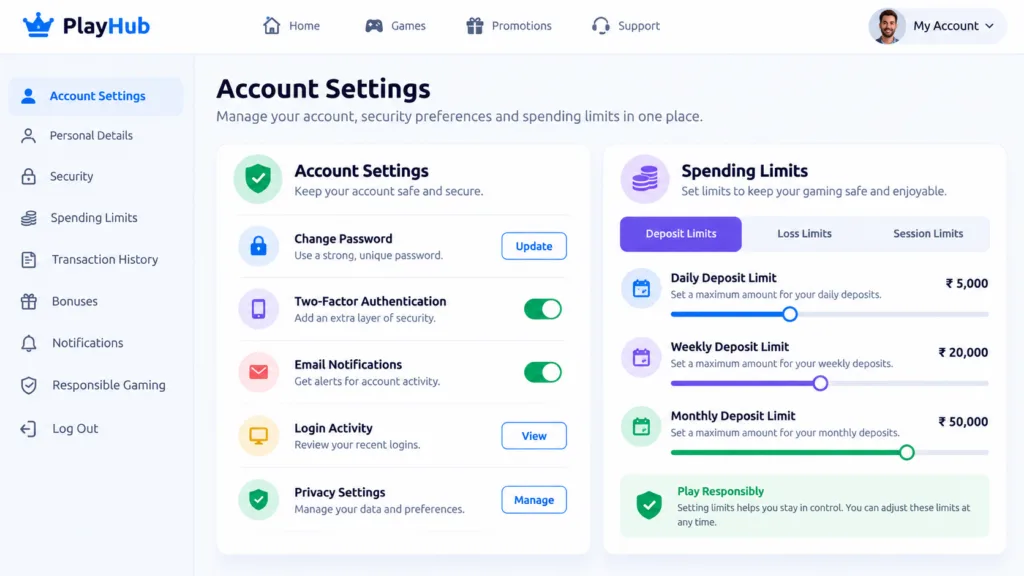
Responsible play tools that actually change behaviour
Responsible gambling features are sometimes presented as a box-ticking exercise. In practice, the useful ones share a common trait: they remove a decision from the moment when you are least likely to make a good one.
Deposit limits
A deposit limit caps how much you can add to your account within a defined period, such as daily, weekly or monthly. It is more effective than a mental budget because it is enforced by the system rather than by willpower. Most regulated operators require a cooling-off period before a limit increase takes effect, which prevents impulsive changes.
Time limits and reality checks
Session reminders and time limits interrupt the flow of play. Long sessions distort perception: players often underestimate how much time has passed and how much has been staked. A reminder is a small intervention, but it works precisely because it arrives when attention is elsewhere.
Cooling-off periods and self-exclusion
A cooling-off period suspends your account for a set number of days or weeks. Self-exclusion goes further and blocks access for a longer period, often a minimum of six months. In Great Britain, the national online self-exclusion scheme GAMSTOP allows a person to block themselves from a large number of licensed sites with a single request. Availability and duration vary by jurisdiction, and self-exclusion is usually irreversible until the period ends, which is the point.
How the pieces fit together
The diagram below shows how game mechanics and player-side controls relate. The game supplies the odds. The player supplies the limits and the decisions. Those are separate layers, and only one of them is under the player’s control.
What Shapes a Responsible Gaming Experience?
Four connected factors help explain how game mechanics, probability and personal choices shape the experience.
Game Rules and Odds
Paytables, RTP and volatility are set by the game design and should be supported by appropriate testing.
Probability
Random outcomes are independent where the game mechanics specify this. Past results do not predict future outcomes in independent random events.
Limits You Set
Deposit caps, time reminders, cooling-off periods and self-exclusion can help you maintain control.
Decisions You Make
Choose your stake size, session length and when to stop. Never chase losses or gamble to solve financial problems.
Keep Gambling in Perspective
If gambling stops feeling like entertainment and starts feeling like a solution to financial problems, stop and seek support rather than increasing your stakes. In Great Britain, visit GambleAware. In the United States, information is available through the National Council on Problem Gambling. Support options vary by location.
Age, jurisdiction and the law you cannot opt out of
Online gambling is regulated nationally, not globally. A site that operates lawfully in one country may be operating unlawfully, or without local permission, in another. The rules that apply to you are the rules of the place you are in when you play.
Minimum age requirements are the clearest example. Most regulated markets set the minimum at 18, but some set it at 21 or apply different thresholds to different products. Age verification is a legal requirement for licensed operators, not a customer service choice.
Jurisdiction also affects what you can access, how disputes are handled and what protections apply if something goes wrong. Playing on an unlicensed site in a regulated market typically removes the protections that licensing was designed to provide, including access to formal complaint mechanisms and, in some cases, any route to recover funds.
None of this is legal advice. Laws change, and they vary. Before registering anywhere, check the current rules that apply where you live and confirm the operator’s licensing position. If the information is difficult to find, treat that as a reason for caution rather than a minor detail.
What to check before you play anywhere
This is the practical part. None of the items below require technical knowledge, and all of them take only a few minutes.
- Licensing information. Find the licence number and the regulator that issued it. Check it against the regulator’s own records where a public register exists.
- Published game information. Look for RTP values and game rules that are easy to locate. Regulated operators are generally expected to make these available.
- Bonus terms in full. Read the wagering requirement, game weighting, maximum bet rule, expiry period and win cap before opting in.
- Responsible play tools. Confirm that deposit limits, session reminders and self-exclusion exist, and check how to use them before you need them.
- Withdrawal process. Understand the verification requirements, processing times and any fees. Doing this early avoids surprises later.
- Support and complaints. Check how to contact support and whether an independent dispute resolution route is available.
- Your own limits. Decide on a spending limit and a time limit before you start, and treat both as fixed rather than flexible.
If any of these checks fails, that is not a reason to look harder for a loophole. It is a reason to go elsewhere. The iGaming market is large, and the number of operators that publish clear information about licensing, game maths and player protections is considerable.
The bigger picture: why literacy beats luck
The online casino industry has changed enormously in a relatively short period. Games are more sophisticated, platforms are faster, and the boundary between casino products and broader digital entertainment has blurred. What has not changed is the underlying arithmetic. Every game still has a built-in margin, and every session still sits somewhere on a wide distribution of possible outcomes.
That is not a reason to avoid the subject. It is a reason to understand it. Players who know what RTP means, who recognise that volatility shapes the feel of a session without changing its long-run maths, and who read bonus terms before accepting them are simply better equipped to make decisions that match their own preferences and circumstances.
There is also a wider point about how the industry earns trust. Transparency is not achieved by repeating the word “fair” on a landing page. It is achieved by publishing game rules, by submitting software to independent testing, by making terms readable and by giving players tools that work without requiring them to fight for access. Those things are measurable, and players can check them.
The most useful shift any player can make is to treat gambling as a cost, not an investment. Money spent on entertainment is spent. It is not a position to be recovered, and it is not a strategy to be refined until it turns profitable. Once that framing is in place, everything else follows: limits become easier to set, sessions become easier to end, and the maths stops being something that happens to you and becomes something you understand.
Disclaimer
This article is provided for general informational and educational purposes only. It does not constitute financial, legal or gambling advice, and it does not guarantee any outcome. Online gambling involves financial risk, and losses are possible. Readers should check the laws and age restrictions applicable in their jurisdiction, review platform terms carefully and use responsible gambling tools where available. Any reference to a third-party website is contextual and does not constitute an endorsement or independent verification of its services, licensing, security or suitability. Gambling should never be treated as a reliable source of income.